
Monthly Archives: September 2022

Sept. 2022 Advocate: Faculty, students and staff join the People’s March

LGBTQ+ organizing

Faculty, students and staff join the People’s March, tracing 52 years of the struggles of the Queer community

by Rika Yonemura-Fabian (AFT Skyline Chapter Chair) with Evan Kaiser (AFT CSM Executive Committee Rep.)
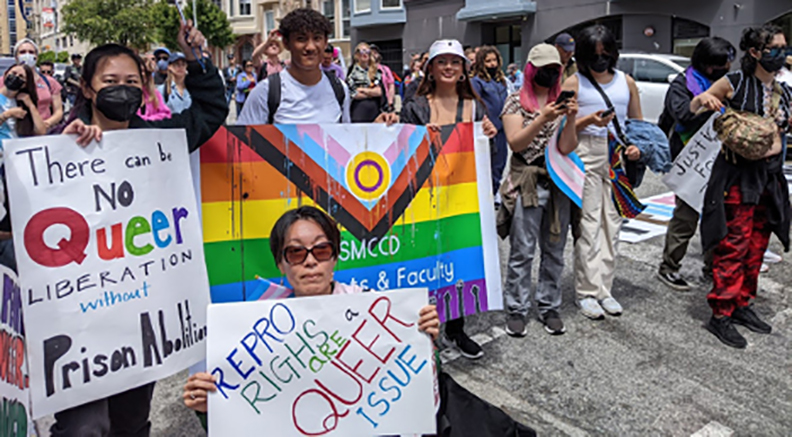

AFT 1493 members and SMCCCD students and staff joined the People’s March in SF on June 30th

Over the years, the popular SF Pride Parade has become increasingly corporatized with a heavy police presence. Queer communities, also a target of police brutality, have been watching this development of the new Queer Capitalism with mixed feelings. Many may have heard of the controversy that erupted this year around the participation of uniformed SFPD officers in the SF PRIDE parade. This critique is important if we look at the precursors to PRIDE marches. Transgender customers at Compton’s Cafeteria stood up to police harrassment in 1966, and trans women of color such as Sylvia Rivera and Marsha P. Johnson played a key role organizing resistance to a police raid on the Stonewall Inn in 1969

Today, the concerns regarding the recent corporatized PRIDE range from the displacement of important issues within LGBTQ+ communities, such as the invisibility of Black/Brown/Indigenous Trans and Queer folks and lack of recognition of these histories of activism, to the police brutality that targets these communities.

The People’s March was born out of that spirit. This year, this alternative march happened on June 30th, overlapping with SF PRIDE in a direct act of protest against the benign festivity the latter has become. AFT 1493 organizers, SMCCCD students, and staff participated in this parade to show solidarity with queer communities and our over 50-year history of resistance.

For many students who participated, it was their first time to learn the history behind the PRIDE parade. For some of them, it was their very first PRIDE march. They could feel first-hand the political edge that the original Stonewall Riot has brought to LGBTQ+ communities.  Before marching, we listened to the rally by the organizers Juanita More!, the legendary drag queen and advocate, and Alex U. Inn from Black Lives Matter. They kicked off the march by saying, “All Black Lives Matter! All Trans Lives Matter! All Brown Lives Matter! All Indigenous Lives Matter!” Alex U. Inn then invited queer participants of color to the forefront of the march, asking white folks to step back to give space.

For Inn, centering QPOC marks one difference between a parade and a protest. Inn believes “…the Pride parade has lost their way. They started out with good intention and that was to emulate the gay liberation movement. Then money changes people left and right…We’re hoping to bring it back to neutral and reset and really have this — the People’s March — be for the people” (Ramos). And as More explains, these chants also explicitly denounce the deaths and murders of Black trans people: “I am most definitely fed up with the killing and the racism in this country and the scapegoating of Black Americans. The Black trans lives we’re losing blows my mind. I feel what we’re now doing is what Pride is really about” (Bravo).

The first PRIDE parade was organized by Gay Liberation Front (GLF), an LGBTQ+ civil rights organization stemming from the Stonewall Riot. This first parade in 1970 in San Francisco had 20-30 members of GLF walking down Polk street demanding their rights and safety from the police. Skyline student Arely Micah (she/they) participated in PRIDE for the first time. She learned the roots of PRIDE and the intention of this People’s March to resurrect the original political spirit. Arely comments, “As a 21 year old nonbinary first generation bisexual, going to pride has been a long-time desire of mine in order to feel embraced and seen when for so long I denied myself the freedom of being. The People’s March was very focused, driven, intentional, celebratory, artistic, inclusive, loving and important for me and so many others in the way that they emulated the core meaning of PRIDE.”

Amanda Ratti (she/her), another Skyline student majoring in Public Health, shared her impression: “The people’s March was refreshingly non partisan, anti-capitalistic and revolutionary, which brings PRIDE back to its roots. It reminds us of who laid the bricks before us so we could march proudly today and I feel honored to have been part of it.”

If you are interested in planning or attending the People’s March in Summer 2023, please contact your AFT organizers, Evan Kaiser (kaiser@aft1493.org) or Rika Fabian (fabian@aft1493.org).
Sept. 2022 Advocate: AFT Flex Day Workshop Report

Membership Outreach

100+ faculty members attend AFT Flex Day workshop

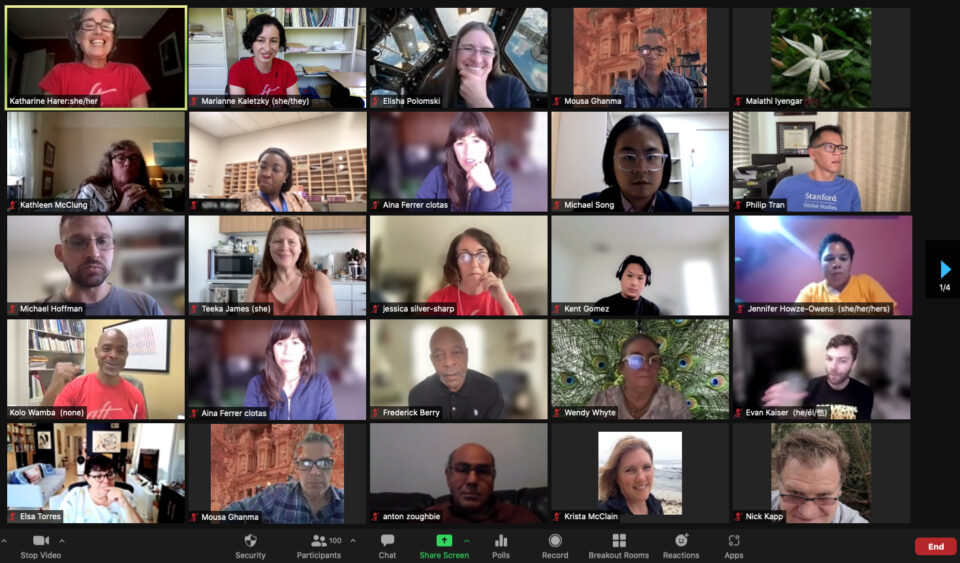
AFT 1493 leaders hosted a Zoom ‘Know Your Contract” session on District Flex Day, August 15. Faculty members were invited to discuss some key aspects of the current contract which the union is currently trying to strengthen through our contract negotiations. As Co-Vice President Katharine Harer welcomed faculty members to the session, the Zoom meeting quickly filled up to the maximum 100 participants. (A number of faculty members were not able to get into the session because the Flex Day Zoom meeting had been set to a 100-participant maximum. The next time we organize a similar Zoom meeting, we will be sure to increase the maximum.)   [Workshop report continues below.]


One member’s perspective on the workshop

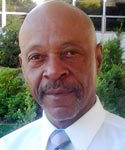
On Flex Day, Monday, August 15, I attended the AFT Contract workshop.  I look forward to AFT workshops as a time to discuss critical issues and engage old friends and colleagues. It was great listening to and discussing contract issues with the warriors on the front lines. They rigorously represent not only the needs and concerns of full-time faculty, but also those of the vast number of part-timers like me—we are never left behind. There were several important full-time and part-time faculty issues discussed with specific proposals that are being negotiated by our team. I just want to say: Thank you team! 
Frederick Berry, Assistant Professor, Communication Studies, CSM


AFT 1493 Chief Negotiator Joaquín Rivera began the presentations by explaining the currently negotiated salary formula that has established the level of faculty salary increases based on property tax revenue that the District receives from the County, and he then described how the union plans to propose a new fairer formula that would provide salary increases that more closely mirror increases in the District’s property tax revenue.

The next set of brief presentations discussed benefits that the union has been working on negotiating or organizing for. AFT 1493 President Monica Malamud described the parental leave that union negotiators have been trying to bargain for and then AFT 1493 Executive Secretary Marianne Kaletzky discussed the new healthcare benefits for part-time faculty that have been won through CFT organizing and lobbying at the State level.  [Read more about new adjunct faculty healthcare funding.]

Monica Malamud next gave a general update on contract negotiations, which have been in process since last May (you can read the latest negotiations reports here) and then there was a short discussion of how members can get involved in supporting union negotiations. Attendees were polled to see what potential support actions they would support and then those interested in getting more involved were invited to attend the Local’s Contract Action Team—CAT.

In the last part of the flex day session, participants divided into two breakout sessions, one for full-time faculty, which focused on the new workload point system and the other–for adjunct faculty—discussed the transition to the new mirror salary schedule for part-time instructional faculty.

If you have questions about any of the information presented at the AFT Flex Day workshop or about any other union-related topics, please reach out to one of your campus AFT reps.

Sept. 2022 Advocate: State provides major funding for adjunct faculty healthcare

Adjunct faculty healthcare funding

Legislature delivers for part-time faculty healthcare as CFT’s coordinated local organizing campaign kicks off

After a summer of continued CFT advocacy, this week the California Legislature passed a budget trailer bill that included critical language – including every component of CFT’s demands – that will make quality, affordable healthcare much more accessible for community college part-time faculty.

With our state budget victory earlier this summer securing a historic $200 million in annual funding for part-time faculty healthcare, the program language found in the trailer bill will help empower local CFT unions to negotiate dramatic healthcare expansion, ensuring that this funding reaches the faculty who need it most, including “Freeway Flyers” who work in multiple college districts.

As the Legislature was taking this important vote, we kicked off the second phase of our healthcare campaign with multi-local membership meetings in both Fresno and Sacramento. These kickoff meetings were a first in a series of regional gatherings throughout the state to prepare for upcoming negotiations at the local level.

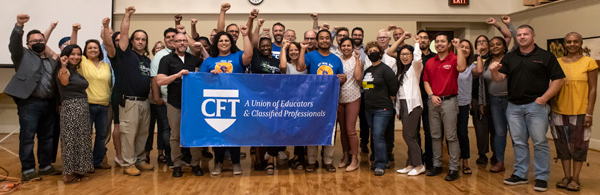
“Our members showed up in force today, to carry this fight forward,” says Keith Ford, president of the State Center Federation of Teachers, who are pictured above. “We are ready to do what it takes to win quality healthcare for part-time faculty.”

For more on the regional meetings, check out the CFT campaign website.

Sept. 2022 Advocate: AFT pushes for improved faculty health provisions

In evolving Covid landscape, AFT pushes for improved faculty health provisions

It’s been a busy year for your union health advocates, and in this article we aim to bring you up to date on organizing and negotiations efforts. On the state level, your local has actively joined the California Federation of Teachers (CFT) in organizing for health insurance benefits for adjunct faculty. After winning $200 million per year in ongoing adjunct healthcare funding from the state, the Legislature has just passed a budget trailer bill – including every component of CFT’s demands – that will make quality, affordable healthcare much more accessible for community college part-time faculty. [Read more about new adjunct faculty healthcare funding.]

On the local front, we’ve continued to educate our Board members and District leadership about faculty’s needs and concerns. AFT 1493 Co-Vice President Katharine Harer laid these out clearly at August 24th’s Board of Trustees’ meeting, explaining how at that time our District had refused to negotiate a new MOU for Fall 2022, with the reasoning that “we’re back to status quo with Covid.” (See the August 24th Contract Negotiations Report.)  During the first two years of the pandemic, AFT had been able to negotiate MOU agreements for a number of health related provisions.

Co-VP Harer explained, “While the union has not taken a position on masking, we’re doing our best to support our faculty…who have expressed concerns for themselves and their students…Tonight we’re communicating their most pressing concerns.” She prioritized top concerns as:

  1. Accommodation process for faculty. While the District says that faculty already had the opportunity to obtain an accommodation if they need one due to possible effects of Covid on themselves or their household members, more faculty may need to request accommodation now that masks are not required. We want the District to agree to respond to accommodation requests without any delays.
  2. Faculty say immunocompromised individuals would like to require that students wear masks in face to face classes. Board policy says masks are strongly recommended but not required. A common sense safety measure would be for faculty to be able to require students to wear masks as needed.
  3. Now that the Covid Health Officer has discontinued contact tracing (except for clusters as required by Cal OSHA), the burden falls entirely on students and faculty to self-monitor, with no enforcement provisions by the District.
  4. Communications about changing policies around Covid have been inadequate, often coming late in the game, inconsistent or confusing. For example, an article in the August 19 edition of the Skyline Shines employee newsletter reported that “masks are required,” yet by that date the County was already in the green tier. (By the Board’s revised policy masks are not required in green).
  5. The Chancellor has recommended creating a task group including reps from the unions and the senates (including students) to discuss and propose Covid-related policies to bring forward to the BOT. We commend this approach and look forward to participating; but we are concerned that this task group will not be making decisions soon enough for this semester; and that more immediate recommendations will come instead from the District Health & Safety Management Committee, which has no faculty representation. (See below)

District Health & Safety Committee has failed to engage participatory governance around Covid-related decision making and policies

Recognizing that faculty deserve a seat at the table on decisions that may seriously affect their health and livelihoods, Cañada’s Safety Committee and Skyline’s Health, Safety and Emergency Preparedness Committee each voted unanimously last Spring to recommend that faculty and staff be able to appoint representatives to the District’s Health & Safety Committee, a management group with the authority to influence policy decisions. While the District committee’s June 6 notes report their goal of improving communications and transparency around their decision making, that committee has thus far declined to act on faculty’s recommendation for representation, which was also supported by classified professionals. The District’s next meeting takes place September 13 at 1:00pm with no agenda posted as of this writing and without any faculty members present.

Improved Communications Needed

Also troubling is that campus safety committee chairs have not been informed, as of this writing, about the Chancellor’s plans for the new ad hoc task group or how this new body might change the role or work of our local safety committees.

Similarly, while the Chancellor explained to the Board in May 2022 that constituent groups, including safety committees, would be engaged during summer to plan for any changes to Covid-related policies in Fall, faculty were not consulted and health and safety committees were not tasked with any policy discussion. Skyline’s College HSEPC committee leadership, in fact, declined to meet in summer.

What is AFT prioritizing now? What can faculty do to move the needle on health and safety?

At their recent August 2022 retreat, AFT1493 Executive Committee members discussed which health provisions to prioritize this Fall. The majority were in favor of continuing to push for an improved and more timely accommodations process and more options for immunocompromised faculty, such as being able to require that students wear masks in class, noting that these types of requests have been refused during current contract negotiations. The majority also favored continuing to allow faculty teaching face to face the option to pivot temporarily to remote instruction if sick or Covid positive. It’s worth noting that faculty’s ability to claim Covid sick time will end this month on September 30 unless extended. (Note: This option was included in MOUs during the pandemic).

Faculty members are encouraged to attend and make comments at AFT’s September 14 membership meeting as well as at bi-monthly CAT meetings where faculty discuss and formulate strategies. The next CAT meeting takes place this Friday, September 9, at 3:30 at this link:  https://us02web.zoom.us/j/7052173089. Faculty with specific questions about Covid testing or other safety measures should reach out to their AFT reps on their campus Health and Safety Committees:

  • Cañada College: Michael Hoffman <hoffman@aft1493.org>
  • College of San Mateo: David Lau <lau@aft1493.org>
  • Skyline College: Jessica Silver-Sharp <silver-sharp@aft.org> or Lori Slicton <slictonl@smccd.edu>

We know you receive a lot of email! To find recent health updates from the District, searching your SMCCD email for “Covid-19 update” will bring up these official communications.

Lifesaving CPR Training available for Faculty

Lastly, adjuncts wishing to participate in paid Heart-saver First Aid/CPR/AED training should plan to take advantage of the training scheduled on October 12 Flex Day at Skyline College, open to the first 25 employees who sign up here: https://www.pda.training/cpr-first-aid-training. Other flex day trainings take place in January and March 2023 at CSM and Cañada, respectively. There is no pay available for CPR training on non-Flex days, as HR does not consider the training mandatory.

Sept. 2022 Advocate: AFT works to reduce class size minimum

minimum enrollment policy

AFT works with Trustees and Chancellor to reduce class size minimum

Hoping to avoid the excessive class cancellations that plagued students and faculty during Summer 2021 — and hearing from concerned faculty that this scenario seemed already to be repeating itself — your Contract Action Team (CAT) met frequently during July to forge an action plan to address the situation, which has been focused largely on the minimum enrollment policy set by the Board of Trustees (in September 2014) at 20 students per class.

Over the summer, with the school year fast approaching, the District’s negotiating team had refused to bargain on the enrollment minimum, and District leaders had not communicated any information on cancellation or enrollment minimums with deans, faculty or students. CAT members feared that without guidance from leadership or any administrative procedures around the policy, some deans might cancel courses indiscriminately and/or without faculty or student input or transparency around their decisions.

Working with Chancellor Claire and the Board of Trustees

CAT began by raising awareness with Chancellor Claire and the Board of Trustees, first that the issue was not being remedied through bargaining, and second on the catastrophic effects that early cancellations might have on our students’ lives and educational plans, our adjunct faculty’s livelihoods, and inevitably on total enrollment numbers and the reputation of the District. AFT reps also explained that many new students choose to enroll in classes up until the first day of the term. AFT President Monica Malamud talked to Chancellor Claire about the detrimental effects of the 20-student enrollment minimum and urged him to contact leadership right away with a message to allow Fall 2022 courses with fewer than 20 students enrolled to run.

CAT members spoke with the majority of Board members individually, asking among other things that the issue of early cancellations be agendized at the next BOT meeting for in-depth discussion. While the Board chose not to do so, on July 28th, new Student Trustee Lesly Ta used her platform as Trustee to share data from a recent student survey she’d conducted to gather feedback and prioritize student voices on the topic of canceled classes. Ms. Ta, a fashion and merchandising student at Cañada College and mother of two young children, summarized the feedback she’d gathered from more than 1,100 SMCCD students in less than a week, showing that class cancellations have a clear and negative impact on the vast majority of students who have experienced them. She also provided the Board with a full report, including the text of student testimonies. She explained further that the Board Policy on enrollment minimums was out of step with low enrollment realities, having been created during 2014, a time of very high enrollment. (View SMCCCD Annual Enrollment Trends: 2011 – 2021)

Chancellor lowers enrollment minimums to 10 students

As a result of these collective actions the Chancellor notified upper management not to cancel classes with fewer than 20 students enrolled, sending a message to all faculty on July 27. He stated, “I have worked with our college presidents and vice presidents and have requested that we drop the enrollment minimums for Fall to 10 students (rather than 20)” and concluded: “I will [be] working with our leadership groups to convene a District ad-hoc committee this fall to develop long-term recommendations and to support our college-level enrollment management plans.”

Many of the points advocated by Ms. Ta, by CAT members and by individual adjunct faculty who spoke to the Board are concerns shared by faculty and students throughout California community colleges. The broader issues were recently highlighted by CFT President Jeff Freitas and Jack McKeever, LA College Faculty Guild President, in their commentary “Canceling community college classes is shortsighted.”

Following Chancellor’s Claire’s direction to temporarily lower the minimum enrollment for a class to run, AFT members kept pushing for a permanent change to Board policy. At the 8/24 Board meeting, AFT members spoke during Public Comments to express the need for a reasonable Board Policy on canceling classes for low enrollment. Sarah Mangin-Hinkley (CSM English) explained why lower class minimums are necessary to fulfill our District’s commitments to our students and community, while David Laderman (CSM Film) discussed why a later timeline for cancellation, codified in Board Policy, would give courses time to fill and better serve our students. They thanked the District for lowering the Fall 2022 minimum to 10 students (rather than the usual 20) and asked the Board to agendize class cancellation policies so that students, faculty, staff, and administrators can work together to create a revised policy that grows our District’s enrollments and, most importantly, puts students first.

AFT 1493 will continue to work to shape policies that offer an equitable working environment for faculty and the best possible learning environment for students. Want to get involved in our campaign? Join our Contract Action Team by attending our CAT meeting this Friday, September 9, from 3:30 to 5 p.m. at this Zoom link: https://us02web.zoom.us/j/7052173089  All AFT members are welcome, even if you’ve never been involved with CAT before. Looking forward to seeing you!