Monthly Archives: September 2022

DISTRICT REFUSES TO NEGOTIATE FALL MOU; MEMBERS SPEAK ON CLASS CANCELLATIONS

In our most recent negotiations session on August 24, AFT negotiators put forward a proposed MOU for Fall 2022. Our MOU proposals include common-sense provisions like the right for faculty to pivot to remote delivery if they are ill but feel well enough to work remotely, rather than having to be absent and hope a sub is available. These provisions aim to ensure student learning is able to continue despite disruptions that are likely due to Covid. Unfortunately, the District’s representatives refused to even negotiate over our proposals for a Fall 2022 MOU, claiming that we are back to status quo, so no MOU is necessary.

In addition, the District refused to show any movement on our proposals for: a month of fully paid parental leave, stronger reappointment rights for part-timers, and a clear timeline and process for faculty with disabilities to obtain reasonable accommodations. These proposals aim to allow faculty to better support our students, and we are disappointed that the District is currently refusing to work towards an agreement on them. Read the full report on our most recent negotiations session here.

At the 8/24 Board of Trustees meeting, which took place just after our negotiations, AFT Vice-President Katharine Harer spoke on the necessity of a Fall MOU given the continuing requirement for faculty who test positive for Covid to isolate, as well as the need for clear District processes and guidelines around Covid. Watch Katharine’s statement below.

AFT members also spoke at the 8/24 Board meeting during Public Comments to express the need for a reasonable Board Policy on cancelling classes for low enrollment. They thanked the District for lowering the Fall 2022 minimum to 10 students (rather than the usual 20) and asked the Board to agendize class cancellation policies so that students, faculty, staff, and administrators can work together to create a revised policy that grows our District’s enrollments and, most importantly, puts students first. Speakers included:

  • Sarah Mangin-Hinkley (CSM English), who explained why lower class minimums are necessary to fulfill our District’s commitments to our students and community.
  • David Laderman (CSM Film), who discussed why a later timeline for cancellation, codified in Board Policy, would give courses time to fill and better serve our students.
  • Vera Quijano (Cañada KAD) also spoke to express her appreciation for the new Adjunct Instructional Salary Schedule, agreed on in AFT’s last contract and implemented this fall, which recognizes adjunct instructors’ education in their pay and offers all the steps to recognize experience that the full-time salary schedule does.

Watch our faculty speakers’ Public Comments below:

We as faculty will continue to work together to win a fair contract and shape policies that offer an equitable working environment for faculty and the best possible learning environment for students. Want to get more involved in our campaign? Join our Contract Action Team by attending our CAT meeting Friday, September 9 from 3:30 to 5 p.m. at this Zoom link: https://us02web.zoom.us/j/7052173089

All AFT members are welcome, even if you’ve never been involved with CAT before. Looking forward to seeing you!

ENCOURAGE STUDENTS TO APPLY FOR OUR PAID UNION INTERNSHIP

AFT 1493 is seeking two SMCCCD student interns who want to learn more about organizing techniques, the structure and functioning of labor unions, and the role of the labor movement in public education. The interns must be current SMCCCD students. They will receive $2000 for work during the 2022-23 academic year, with total hours not to exceed 100 per intern.

Read the full Request for Applications for AFT 1493’s Paid Internship here

Sept. 2022 Advocate: Gender Oppression Task Force organizes to strengthen District’s Title IX processes

Anti-Oppression Organizing

AFT 1493’s Gender Oppression Task Force organizes to strengthen District’s Title IX policies and procedures

by Kolo Wamba, AFT 1493 Skyline College Executive Committee Rep.

AOC is AFT Local 1493’s Anti-Oppression Committee. Led by Skyline sociology professor and AFT Chapter Chair Dr. Rika Yonemura-Fabian, AOC was formed in Fall 2020 with the express mission to vigorously defend the right of students, classified professionals, and faculty to learn and work in an environment free of oppression.

In Fall 2021, the AOC formed a Gender Oppression Task Force and began to explore the issue of gender oppression in the teaching and learning environment.  Part of this activity entailed reviewing how our District implemented Title IX policy and we found several troubling discrepancies and irregularities. Title IX is, of course, the landmark federal civil rights law that was passed in 1972 which specifically prohibits sex-based discrimination in schools or educational programs that receive federal funding.  From our review, it was clear to the AOC gender oppression task force that our District, which has a legal obligation to fully comply with Title IX, has been sloppy, opaque, slow, and generally inadequate when it comes to protecting students, classified professionals, and faculty from discriminatory behavior and gender-based violence.  The District’s Title IX reports sometimes get lost, cases often take unreasonably long to investigate (if they are investigated at all), it is never clear exactly what is happening during a given Title IX process, and it has not been made obvious what, as mandatory reporters, our specific roles and responsibilities are or how to fulfill them.The committee also could not find the evidence that the District was offering timely and sufficient measures to protect the filers from retaliation.

AOC sends open letter to District leadership demanding changes to Title IX processes 

This sorry state of affairs led AOC in December 2022 to prepare an open letter to District leadership decrying the state of Title IX in our District and making 8 specific demands, which can be summarized as follows.

  1. Provide a flowchart of investigation processes of Title IX cases, accessible to all District community members and publicly posted online.
  2. Share districtwide the organizational chart that indicates the District- and College-level personnel who are responsible for investigating and acting on Title IX complaints.
  3. Specify whether SMCCCD has a Title IX investigator within the District and/or Colleges. If so, explain how this individual is chosen and the criteria used to select the investigator.
  4. Explain how Title IX coordinators are chosen and the criteria used to select them. Additionally, indicate how the selection process ensures that their identities and backgrounds promote accessibility, inclusivity, and the necessary level of trust required for reporting matters as sensitive as gender-based aggression.
  5. Articulate a clear definition of retaliation and specific protocols to prevent retaliation, and specify what protections are available to the reporter/complainant.
  6. Provide thorough institutional support for victims of gender aggression.
  7. Offer an updated and required Title IX training to all SMCCCD employees, including administrators and students.
  8. Provide transparency regarding how the District identifies and addresses patterns of harassment (including repeat offenders).

Chancellor responds

The letter was endorsed first by our Local and then by the three college Academic Senates. In the meantime it was also shared with Local membership as an Action Network petition.  However, before we could present our case to the Board of Trustees – and even before the petition went live, Chancellor Claire’s office, which had somehow gotten ahold of the letter ahead of time, issued a detailed and lengthy response.   In it, the Chancellor provided incomplete answers to some demands; and for other demands, the Chancellor’s office claimed (with insufficient evidence) that the specific demand had already been met.

In due course AOC responded with a list of questions for Chancellor Claire and the District, and were granted a meeting with District HR and the Compliance Officer to go over the District’s answers to our questions. The meeting, which took place over the summer, proved inadequate to address all of our concerns. For example, one of our original demands was for the District to publicly post online a detailed flowchart depicting the sequence of steps in a Title IX process– but as of this writing, this has still not taken place.  Moreover, we have learned in the meantime from our Local’s legal counsel that the District appears to be out of compliance with its Title IX reporting requirements to the Office of Civil Rights (OCR), and has been for quite some time.

Some progress from District

Where there has been progress has been in getting the District to recognize the importance of Title IX and to realize that adequate resources must be committed to ensuring that it is fully upheld.   The District has taken steps to update its administrative procedures, and at Flex Day last spring District HR ran a helpful workshop on Title IX and Title V that was very well attended.  Both of these are positive incremental developments that may not have taken place had it not been for the efforts of AOC over the past year.

Have you had experiences with District’s Title IX process?

Still, the fight is far from over.  We still need to get the District to afford the appropriate level of seriousness and clarity to Title IX (of the sort exemplified by, for example, by the San Diego Community College District) but with the continued support of our Local membership, we will get there.  AOC would like to thank our members for their continued endorsement of our work – we couldn’t do this without you!  If you are interested in getting involved with AOC, please contact Rika at fabian@aft1493.org.  AOC is open to everyone in the community and there’s no formal process to join – just drop in on any of our meetings whenever you have the time.  We especially would like to hear from members who have had difficult experiences with our District’s Title IX process, particularly in those cases where they’ve had to file a report on behalf of a student.  If you are in this predicament, you are entitled to recourse, and we can help you file a formal complaint with OCR.  We suspect that there are many people in our Local who are in a similar situation, and we strongly encourage each of them to come forward.  The more complaints the OCR receives, the more pressure we place on the District to clean up its act.  Let’s win this fight, and get a fair and transparent Title IX policy for all!

Sept. 2022 Advocate: Legislation Shortchanges Language Learners

Legislation on “Remedial” Ed

AB 705 and 1705: Legislation for “equity” shortchanges language learners

by Leigh Anne Shaw, Professor, ESOL, Skyline College

English language learners nationwide have historically faced inequitable access to higher education, but California has always been different. Our 116 colleges have, until now, included robust offerings in English to Speakers of Other Languages (ESOL, or ESL). Since AB 705’s implementation in 2019, credit ESOL section offerings and enrollment have plummeted (ICAS 2020) despite continued need. How did “progressive” legislation to broaden access demolish service to language learners?

In a world emphasizing money and time, legislators don’t want to subsidize “empty calorie” units like ESOL. They see ESOL as an expensive barrier, trotting out statistics showing how ESOL learners take longer to complete their pathways. Of course they do; academic fluency in a language takes time. Legislators do not want to pay for that time, so they cut English language learners loose and shift focus to native speakers, who can be pushed through the pathway more quickly and cheaply.

ESOL is not the remedial coursework that AB 705, 1705, and 1805 address; it is a foreign language to those learning it. A non-transferable ESOL class is as rigorous as a transferable World Languages class. Students transferring with four semesters of Spanish do not proceed to take all of their subsequent coursework in that language, while students completing four semesters of ESOL do exactly that. Degree-bound ESOL learners must then take additional units of a transferable foreign language, taught in English, because their ESOL doesn’t transfer. When transfer-reformers decry adding unnecessary units onto transfer, why aren’t they pushing the UC and CSU to count ESOL rightfully as a foreign language?

Then, there’s placement. Any quality language program needs a placement test to match students to coursework. Under AB 705, however, students may opt out of placement tests, making accurate course recommendations difficult. ESOL can still use approved placement tests, but the state isn’t required to approve new tests as old ones expire. There is one approved test left on the list, and it expires in 2023; recent memos show the state is not approving more. Colleges cannot place students into a pre-collegiate course without demonstrating the student would be unsuccessful without it. Conveniently, by removing placement assessment, that data is impossible to gather, so the proponents of these bills never have to acknowledge that some students might need pre-collegiate coursework such as ESOL.

These bills create inequity by denying the existence of ESOL learners. Students who are placed directly into transfer-level English (TLE) per AB 705 rules are never identified as language learners in the first place. This means colleges have zero data points to show whether success in TLE, or lack thereof, had anything to do with language proficiency. By the time a student’s language needs are discovered, they are on a fast-moving educational plan. Backtracking to ESOL will waste time. The proponents of these bills never get to see the numbers of unserved English language learners and thus never have to evaluate the choice to force everyone into a one-size-fits-all pathway.

AB 705’s partner bill, AB 1805 (2018), requires informing students of their ESOL options. This is great, if ESOL students have the language proficiency to understand the affidavit they sign. But proposed AB 1705 will effectively render moot that provision by preventing counselors from even discussing pre-collegiate course options such as ESOL.

How is this serving high school language learners? K-12 schools are required to assess and categorize language learners as “Limited English Proficient (LEP)” or “Fluent English Proficient (FEP).” But FEP status does not necessarily mean “fluency.” It only gives “an arbitrary threshold of English language proficiency (typically the 36th percentile on a standardized test)” so that schools can “mainstream” students into regular classes (Rumbaut 1995).  Thus, students can and do arrive to college still needing English. Yet, under AB 705 placement rules, any student who has spent any time in a U.S. high school is automatically placed into transfer-level English regardless of English proficiency.

And what about adult learners? High school students only make up 30% of ESOL statewide. Fully 70% of ESOL is adults, many with foreign degrees and no high school ID marker. By eliminating placement testing, colleges blend adult ESOL learners into the background. Matriculation is structured for high school students, not nuanced for non-traditional adults. The RP Group, whose research powers the bills, admits they have no data on adult ESOL learners because it’s too difficult to ascertain, so they leave them out of success data analysis. That’s how ESOL becomes marginalized by bills ironically designed to create greater equity.

Indeed, AB 705 (2017), AB 1805 (2018) and AB 1705 (proposed) talk a good game about serving those privileged enough to call English their mother tongue. Eliminating assessments that forced native-speakers of color to languish in remedial education was the right thing to do. But nearly 90% of ESOL learners are students of color (NCES 2015), and there are no equity discussions about them. These bills deny ESOL learners equity by ignoring their language-learner status.

Preventing ESOL learners from appropriate placement into language pathways is myopic and reckless. It is a systemic choice that reveals the state’s value of native English speakers over English learners. Colleges cannot proudly wave the flag of equity while ignoring the needs of English language learners.


Sources:

ICAS 2020. Bean, M. V., Carr, N., Kern, R., Lee, J. W., Maldonado, M., & Shaw, L. A. (2020). ESL Students in California Public Higher Education: 2020 Update. ICAS ESL Task Force. https://asccc.org/sites/default/files/publications/AS_Position_Paper-ESL_210826.pdf.

NCES (2015). Indicator 8: English Language Learners in Public Schools. National Center for Education Statistics. https://nces.ed.gov/programs/raceindicators/indicator_rbc.asp

Rumbaut, R. (1995) The New Californians: Comparative Research Findings on the Educational Progress of Immigrant Children. https://www.researchgate.net/profile/Ruben-Rumbaut/publication/234726051_The_New_Californians_Assessing_the_Educational_Progress_of_Children_of_Immigrants/links/5bca9738a6fdcc03c7961663/The-New-Californians-Assessing-the-Educational-Progress-of-Children-of-Immigrants.pdf
 

Sept. 2022 Advocate: AFT members meet with Amazon Union president Chris Smalls

Labor Movement Organizing

AFT members show solidarity at labor convention meeting featuring Amazon Union president Chris Smalls

by Evan Kaiser, AFT 1493 CSM Co-Executive Committee Rep.

AFT members with Amazon Labor Union president Chris Smalls (back row, center) at California Labor Federation Biennial Convention on July 25th, 2022

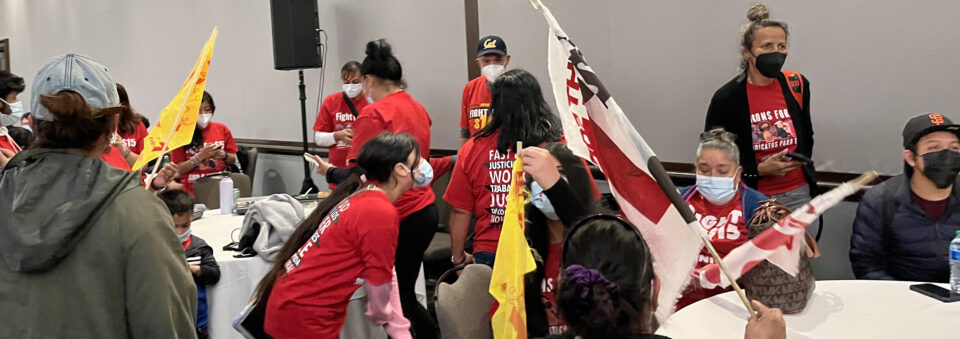
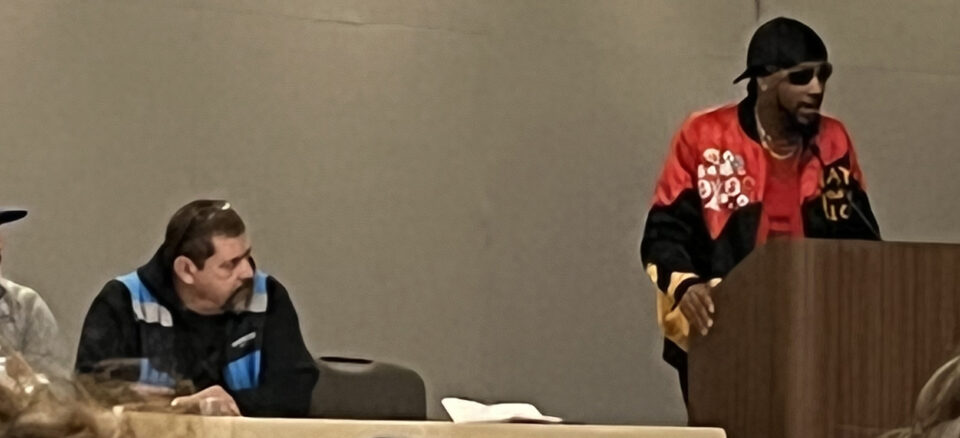
The energy in the conference room of the California Labor Federation Biennial Convention was electric as Amazon Labor Union president Chris Smalls approached the podium. To my left, fast food workers and members of the Fight for Fifteen campaign raised their voices in a chorus of “Sí, se puede,” echoing the motto of the United Farm Workers. In front of me, tables of Teamsters, CFT delegates, and the newly created Starbucks Workers Union burst into a raucous applause.


Members of the Fight for Fifteen campaign gathered at the California Labor Federation Convention


Amazon Labor Union president Chris Smalls at podium

Smalls began his remarks by asking for a brief moment of silence to recognize those lost to COVID and to acknowledge the impact of pervasive violence we have witnessed in the U.S. and abroad. In this poignant space that seemed to last for minutes rather than seconds, I thought about my colleagues struggling to protect their young children from COVID. My mind then jumped to the children killed in Uvalde, Texas and the missing systems of care and support that failed to protect all involved. I was reminded of my relative privilege as a “knowledge worker” brushing up against an ever elusive middle-class standard of living. And then, Smalls jolted us out of that emotional place, as we offered to each other what was both a solution and a promise: “I got your back!”

Workers across industries are likely familiar with Chris Smalls’s story and his rise to the forefront of the current U.S. labor movement. After being fired from Amazon, he successfully used grassroots organizing tactics to fight union-busting and help establish Amazon’s first labor union. Although intent on improving the grueling and substandard conditions in Amazon procurement facilities, his calls for worker solidarity resonate far beyond the (very high) walls of that one company. Indeed, worker solidarity and proactive union activity may be the only antidote to the power concentrated in corporate bosses’ billions of dollars in assets. As Smalls recounted, the leaders of big corporations like FedEx and Amazon would rather roll out thousands of pro-company, anti-union marketing jobs targeted at teenagers than invest that same money into folks who already work in the logistics and service industries. Perhaps this is because they know, as we do, that workers already wield immense power – if we organize.

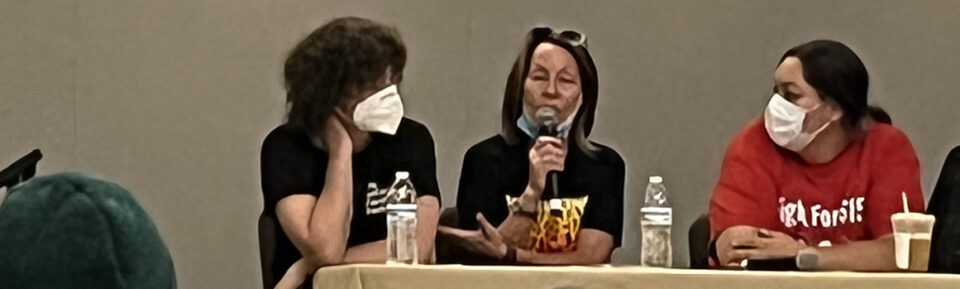
Other panelists spoke of their own unionization efforts, occasionally asking Smalls for commentary or advice. Manuel Ramos of the Mobile Workers Alliance explained the financial toll of maintaining his own vehicle as a misclassified Independent Contractor for Amazon who was also subject to unfair deactivation. Ramos was followed by SF Labor Council Executive Director Kim Tavaglione, CFT organizers Sandra Weiss and Arden Stern, and Fight For Fifteen organizer Crystal Orozco, who asked Smalls for advice on where we go from here. Besides making the labor movement cool (hot labor summer, anyone?) and the importance of teaching real history, much of which is labor history, Smalls stressed building solidarity across perceived divides and activating every member to do the work.


From left to right, CFT organizers Arden Stern and Sandra Weiss, and Fight For Fifteen organizer Crystal Orozco, spoke on the panel at the California Labor Federation Convention

Both of these messages are key to our success as AFT – and when I say “our,” I don’t mean the Executive Committee. I mean each one of our thousands of members who are diverse in terms of economic status, race/ethnicity, gender, political orientation, and so on, but who are united in the desire to create a dignified workplace that pays enough to cover our personal expenses and supports our professional aspirations to do our best by our students. There are so many ways to move the needle towards this goal, such as building 1-1 connections with your department colleagues (especially your part-time faculty colleagues!), volunteering to be a Contract Action Team “point person,” or participating in union actions like “red for ed” days or speaking publicly at Board of Trustees meetings. This spirit of solidarity that we cultivate will extend well beyond our three campuses; it is what pushed CFT to the brink of victory in a campaign to secure $200 million for part-time faculty healthcare, to take one recent example. So this fall, let’s all take action to show up for our colleagues – or, as Chris Smalls said, show them that “I’ve got your back!”