
Faculty colleagues,
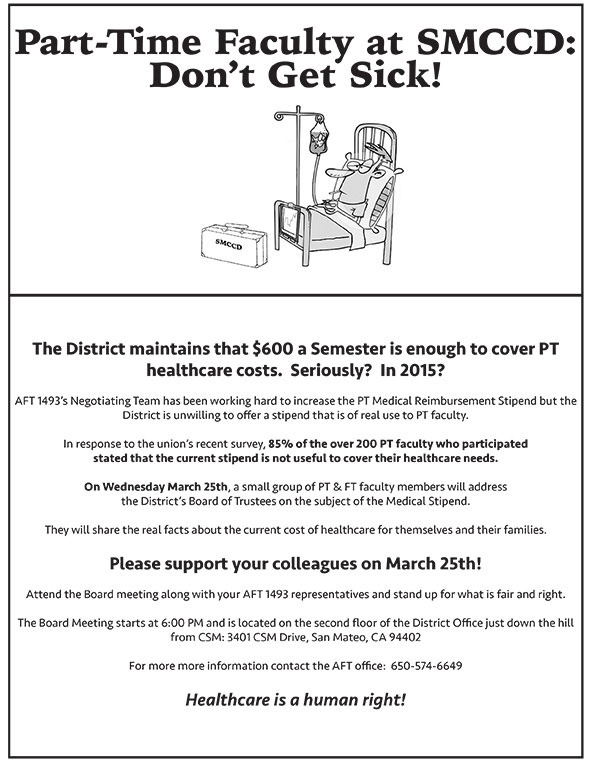
Do you feel that $600 per semester is an adequate sum of money to help adjunct faculty pay for medical expenses? Here are some quick facts:
The AFT Negotiating Team researched the amount of coverage provided to part-time faculty in the Bay 10 community colleges, and only one other college (which offers NO benefits whatsoever for part-timers) fell below our district. In fact, of the ten districts, seven offer part-timers coverage through Kaiser or another health plan. Only one district aside from ours provides a stipend and the other district’s stipend is $400 more per semester than ours. For a more detailed comparison of benefit contributions by district, click here to see the chart.
The union’s recent survey of part time faculty uncovered serious inequities in healthcare coverage for part-timers. 30% of the part time faculty who responded to the survey pay for an individual health insurance policy (i.e., they are not covered by any employer, their spouse or Medicare), and 8% are either uninsured or under-insured. The average monthly payment of out-of-pocket health expenses by part timers who answered the survey was $459.98. That’s $5,519.76 per year! Even among faculty with the most modest out-of-pocket payments, the district’s stipend only covers one-half of their annual premiums, not including co-pays and other fees. If you missed it in the February issue of The Advocate, you can read the full report on our survey here.
On March 25 at 6:00pm, a group of five faculty members, both part-time and full-time, will be making a presentation to the District Board of Trustees on this issue. Your colleagues will share a combination of evidence-based arguments and real-life testimonials in an attempt to persuade the Board to support an increase in the medical benefits stipend — from $600 to $1600 per semester. We need your support to make a strong showing. The more faculty members who show up for this agenda item, the more powerful the statement. If you are able to attend, please RSVP to kaplan@aft1493.org by Monday, March 23rd. If you have any questions feel free to reply to this email. Join your colleagues to show the district that this issue matters to all of us.
Thank you for your time and your action!
In Solidarity,
Your AFT 1493 Executive Committee
Wednesday, February 18, 2015, at Skyline College
EC members present: Najla Abrao, Eric Brenner, Vicki Clinton, Katharine Harer, Teeka James, Dan Kaplan (Exec. Secr.), Michelle Kern, Doniella Maher, Monica Malamud, Sandi Raeber-Dorsett, Joaquin Rivera, Paul Rueckhaus, Elizabeth Terzakis, Rob Williams, Shaye Zahedi.
AFT (non-EC) members present: Shana Whitney (ECE and Health Science – Skyline, representing Skyline Academic Senate at today’s meeting), Nina Floro (English – Skyline), Masao Suzuki (Economic – Skyline).
Guests: Zev Kvitky (CFT Field Rep)
Meeting began at 2:45 p.m.
Facilitator: Rob Williams
Done.
None.
Approved unanimously.
Survey closed last week, with a good response rate, approximately 30% of PT faculty. PT are spending anywhere from $200 to $2000 a month for their medical expenses. Our average PT, if they were teaching a full-load in the District (hypothetical but impossible, for calculation/comparison purposes only), they would have a salary that would require them to pay approximately $450 a month in the Covered CA exchange
Joaquin reported that when the survey results were brought up during negotiations, Eugene was very dismissive (“only 80% of the PT faculty say that the stipend does not meet their needs? I would have expected 100%” and when shown a chart showing how poorly our District compares among the Bay 10 in terms of PT benefits: “we cannot look at benefits in a vacuum”).
We need to escalate this campaign. Some ideas:
Negotiating teams met last week. Not much progress. There is another negotiation session scheduled for February 27.
Medical Benefits:
Current AFT proposals:
District’s position:
For the last negotiation session, Joaquin prepared a comparison sheet with PT benefits in the Bay 10. Eugene said that he could not consider information “in a vacuum”, by which he meant that salaries needed to be included in the comparison as well.
Joaquin prepared a salary comparison of FT salaries in the Bay 10 and shared this information at the AFT meeting. We fare well in our District in terms of salary. But when we compare benefits, our District is towards the bottom of the Bay 10 group. If salaries and benefits are added up together (this is “total compensation”), then our District is in the middle of the pack.
Teaching assignments/Administrators teaching:
We were told that Mike Claire feels he can be a better president by having direct contact with students. The AFT’s response: administrators can take advantage of many other situations in which to have direct contact and meaningful interactions with students.
Katharine and Michelle were asked to do a presentation at the CFT Leadership Conference, to showcase the great work that they are doing in our District, under the sponsorship of a CFT grant. Audience responded positively to their materials and the concept of PT appreciation days.
CSM: no report
Skyline: one division is planning a PT appreciation event
Cañada: recently had an AFT all-faculty meeting (see below). The college also holds a PT appreciation event.
7.b. All-faculty AFT meeting at Cañada (added to the agenda)
Elizabeth reported on the AFT all-faculty meeting at Cañada. Much of the conversation revolved around class cancellations and how they affect programs and professor’s loads. Attendees are taking these issues to all the meetings in which they regularly participate. Cañada faculty in attendance also requested that there be an evaluation of higher level administrators. The District has not followed up on conducting a Deans’ survey.
We have received a fine report from our Auditor, Josh Pooley.
In a nutshell, income in our budget has gone down, while expenses have gone up. Some factors: increases in per capitas, retirement of FT faculty with high seniority, replaced by new hires who are lower in the salary scale. Our unit is over 1000, so we now get the 60% rebate rate from the CFT on our paid per capitas, instead of the 70% rate we used to get when our unit’s size was under 1000 faculty.
According to Dan, we are going to have to raise our dues. We have a good financial cushion, so we do not need to do this immediately, but we should have further discussion on this topic.
We will have a meeting with Academic Senate presidents on Monday, March 2nd, at 3:45 pm.
Eugene is proposing Board Policy, and accompanying Administrative Procedure, about Civility and Anti-Bullying (another reincarnation of the Mutual Respect policy). There are laws governing much of what this proposed policy intends to address.
Zev shared that what works against bullying is a “program”, not a policy.
Watch out for this coming up in Senate meetings.
Dan had a meeting with John Searle, Ernie Rodriguez and John Kirk. These retired faculty expressed a desire to have some participation in the District, working with students. They will be approaching Ron Galatolo about this idea, and they will write an article for the Advocate about this.
Doniella announced that Cañada will be hosting events with her on March 12 at 10 am and 5 or 6 pm.
Doniella/Elizabeth: Favianna Rodriguez, artist and activist, will be at Cañada for two workshops in March.
Monica: wrote a CFT Convention resolution, “Free Community College”, submitted by ELL Committee.
Meeting adjourned at 5:05 p.m.
Five faculty members– two full-timers, three part-timers–made presentations to the Board of Trustees at the March 25 Board meeting. View the presentations below.
See a comparison of part-time faculty health benefits in “Bay 10” community college districts.
Links to YouTube videos: