Monthly Archives: October 2025

Negotiations Report #22, Part 2

    See All Negotiations Updates   


October 29, 2025


Before we get to the Bargaining Report:

  • Red Shirt Wednesday Reminder– we are re-ordering shirts a third time this semester because so many faculty have been participating!
  • Please RSVP here to join our Informational Picket Line at the Board of Trustees on Wednesday, Oct. 29th, 4:15-5:15pm. This is our last big action before we likely head into impasse.

The main takeaways from our twenty-first negotiation session on Oct. 24th:

This negotiation session was basically a farce. We came prepared and ready to bargain; the District, on the other hand, entered with a pre-meditated plan to go to impasse instead of presenting counteroffers they owed us on Compensation (Art. 8), Health & Welfare Benefits (Art. 9), and Retirement (Art. 10).

It’s not hard to see why the District prefers impasse to making an offer on these economic issues in negotiations: they don’t want you to see their lowball offers! Our boycott and rally on Flex day spooked them, proving that our faculty are fired up and united in our fight for a fair contract. As a result, the District is retreating to impasse so they can hide their offers behind the cover of confidential mediation sessions, trying to suck the air out of our contract campaign’s momentum. So our job is to keep escalating: keep organizing our colleagues and our students, and build to strike-readiness, which we’ll discuss at our Nov. 12th Membership meeting.

Over the coming weeks & months, do not forget that the District refused to protect your Academic Freedom even though it wouldn’t cost them a penny to do so, and that the District’s last compensation offer to you was for 2.75% / 3.25% annual raises (full-time and non-instructional adjunct / instructional adjunct salary schedules). That’s less than inflation/COLA, far less than the District revenue increase %, less than the offer they’ve already made to our sibling unions AFSCME and CSEA (4%/3%/3% plus $3,000 stipends), and far less than comparable Basic Aid Districts Marin and West Valley-Mission gave their faculty recently (15% over 3 years).

Let that fuel your fire! 


Current Bargaining Report

AFT Negotiation Team: Monica Malamud (Chief Negotiator), Chet Lexvold, and Luis Zuñiga.  Also in attendance from AFT were President Rika Yonemura-Fabian and Observers Mick Song, Lale Yurtseven, and Gampi Shankar.

From the District: Ellen Wu, Richard Storti, Julie Johnson, Aaron McVean, Gerardo Ramirez, and Max Hartman.


Workload (Article 6 and Appendix D)

We brought counter #4 on this article.

  • On 6.1, we brought back the copied and pasted language from Appendix F that explains that although 30 FLCs is considered a full-time assignment, 28-31 FLCs are acceptable.
  • We accepted their strikethrough of our proposed language that said if ancillary work can be loaded, the District shall report “reportable” time spent on ancillary work to CalSTRS (the District should already be reporting this to CalSTRS).
  • In 6.3 we accepted their language about PT faculty receiving payment for ancillary work, but we proposed added language that the District must justify, in writing within 7 days, if for some reason Deans or the District do not approve payment for ancillary time.
  • On 6.6, we proposed status quo as we are not making progress here.

Appendix D

  • In A2, we again brought back “mental health student club advising,” “receiving” clinical supervision for licensure, and “peer consultation.”  We acknowledged that all other club advising is voluntary; however, advising the Active Minds club requires professional expertise from a licensed personal counselor and is listed in the job description for postings for open positions.
    • Regarding the “receiving clinical supervision” section, we responded to the District’s argument from the previous session by pointing out that from 2017-2024, there were 6 counselors who needed to receive clinical supervision in order to become licensed, and currently at Skyline, 3 are not licensed and receive clinical supervision.
  • In A3, we struck out the word “scheduled” because it conflicted with the “not scheduled” phrase in the same sentence regarding when counselors must perform professional duties on campus.
  • We re-added “work performed as a program coordinator” to the list of ancillary work and rebutted the District’s (false) argument that listed ancillary activities in a CBA must be related to examples provided in Ed Code, citing commencement as one such example of an ancillary activity in our CBA that is completely unrelated to examples listed in the Ed Code.

When we returned from caucus, the District said they rejected all of our proposals and we are at impasse on Article 6 / Appendix D.


Academic Freedom (New Article)

The District again refused to bargain on academic freedom, claiming it’s not a mandatory subject of bargaining.  In a bizarre twist, the District, for the very first time, also claimed that academic freedom is in the contract in Article 15 and Appendix G, which have to do with evaluations.  When we pointed out that’s only with regard to evaluations, the District tried to argue that’s the only place faculty need academic freedom protections. Both Monica and Luis from our team pointed out it could come up in curriculum development, grading, any lecture, and a number of different places.  Then the District said the Board policy and investigation procedures are for those situations. There was much back-and-forth over this, including a discussion about a recent grievance and PERB case we brought on behalf of one of our faculty members whose academic freedom was not protected despite the existence of the Board Policy. In another odd argument, the District claimed that the investigation process determines whether lecture content is appropriate or not, not faculty expertise. The District tried to claim that even though there was a finding against our faculty member in that case, because they didn’t discipline the member, it proved we don’t need academic freedom protection in our contract.


Chet’s note: The above exchange shows the District 1) refuses to understand what academic freedom entails, despite the numerous occasions in which faculty spoke to educate the Board of Trustees on what academic freedom means to us in the context of our professional duties, and 2) wants total power to decide what is and isn’t protected by academic freedom. That is why they refuse to bargain on this topic that would cost them zero dollars to incorporate into our contract.


Compensation, Article 8

The District didn’t bring a counter to our last proposal, instead claiming we are at impasse. Their last proposal on comp was Sept. 18th, and prior to that, their last compensation proposal was July 17th.


Article 9, Health and Welfare Benefits

  • Even though we had moved 3% on the District’s coverage for premiums for two-party and family Kaiser plans in our previous counter, the District refused to make a counter and said they want to file for impasse on this article.
  • Throughout all our negotiations, the District never made an offer to increase dental coverage one penny. The current amount they provide is $2,000, and since that number is a flat number and not a %, it hasn’t increased in many years despite dental costs obviously increasing simply due to inflation over that time.
  • Also in our previous counter we had moved on our proposal regarding salary continuation insurance, but again the District refused to make a counter.


Article 10, Retirement

The District didn’t bring a counter to our last proposal, instead claiming we are at impasse. In our previous counter, we had proposed that for anyone who retired after June 30, 2025, the healthcare contribution would go up to $1,000/month (from $450) until they reached Medicare-eligibility (65).  Over the last three years, only 10 retirees were under 65, and two were 64. This is a nominal number, yet the District refuses to offer anything different than the $450 amount that has been in the contract for decades.


Hours of Employment (Article 7)

  • On 7.6.1, we are close to agreement with the exception of one meaningful word: “scheduled.”  The District wants to have it, and we want to strike it.
  • On Flex Days, they accepted our rejection of their proposed “on campus” requirement for required flex days.
  • 7.13 they agree it’s repetitive but want to keep this language here and in Article 8; our counter is to just put “See 8.13” here.


Safety Conditions of Employment (Article 16)

The District again rejected our language about faculty having the right to stop class if there’s a safety concern.  We have agreed to some language about putting up posters specific to transgender and gender nonconforming employee rights on campuses, but have not reached agreement on the specific location(s) of where these should be posted.


Faculty Load Credit (FLC) Allocation (Appendix F )

There has been no movement from the District here.


Part-Time Employment (Article 19)

The District did not present a counter to our proposal on this article.


Summer Employment (Article 18)

We cannot present a counter on this article because it would reference sections that are currently being negotiated, so we’re setting it aside for now.


Dual Enrollment (New Article)

We did not present a counter on this article; there has been so little movement on it by either party, we are setting it aside for now.


Professional Development Leave Program, Article 13.

We have reached a Tentative Agreement on this article.


Reasonable Accommodation (Article 25)

We’ve reached a tentative agreement on this article.


Grievance Procedure (Article 17)

We’ve reached a tentative agreement on this article.


Informal Complaints and Formal Misconduct Investigations (Article 23)

We’ve reached a tentative agreement on this article.


In Solidarity,

Chet Lexvold
Executive Director, AFT 1493
lexvold@aft1493.org

Negotiations Report #22: DISTRICT DECLARES IMPASSE

    See All Negotiations Updates   


October 27, 2025


Go here for Negotiations Report #22, Part 2, for the gritty details of this week’s bargaining session. 

Dear Union Siblings,

In negotiations on Friday, the District said they intend to file for impasse with the Public Employee Relations Board (PERB), thus canceling our last negotiation session we had scheduled for this Thursday.

Here and pasted below is my two-minute instant reaction video we posted to our Instagram account on Friday (spoiler: the last compensation offer the District made was for 2.75% annual raises).

We’ll have more details about impasse and what comes next in future communications, but just know that the fight for a fair contract continues unabated! We need to continue to build solidarity and show that faculty are united in our fight for a fair contract.

In that spirit, can you join our Informational Picket Line on Wednesday, Oct. 29th, 4:15-5:15 at the SMCCD District Office? RSVP here

We know many students are planning to join us, so please invite your students, too! The Trustees will be arriving for their 5pm meeting between 4:30-5:00, and our goal is for them to walk into this meeting having just walked through our picket line, a classic symbol of workers on strike ✊.

In solidarity,

Chet Lexvold
Executive Director, AFT 1493
lexvold@aft1493.org


View this post on Instagram


A post shared by AFT 1493 (@aft_1493)

Negotiations Report #21

    See All Negotiations Updates   


October 17, 2025

[Note: This one is later than usual because of activities related to our Flex Day Boycott and Rally; this negotiation occurred Oct. 3, 2025, prior to our Flex action on Oct. 8, 2025.]


The main takeaway from our twentieth negotiation session on Oct. 3rd:

The District refused to move on Appendix F (Faculty Load Credit (FLC) Allocation), which is where we’ve been proposing increased FLCs for various labs and class maximums for Calculus and English Composition classes.  There are only two more negotiations scheduled this fall, and we have one final push to make before we likely go to mediation and/or impasse.


!! Please RSVP here to join our Informational Picket Line at the Board of Trustees on Wednesday, Oct. 29th, 4:15-5:15pm. This is our last big action before our final negotiation scheduled this fall on Oct. 30th.

Also, you can sign up to join us at a negotiation session, including the next one on Friday, Oct. 24, from 1:00-4:00pm.  And of course, continue Red Shirt Wednesdays- we are re-ordering shirts because so many faculty have been participating this semester!

Finally, fill out the Bargaining Priorities Survey if you haven’t yet to let us know your thoughts on the remaining issues we are negotiating.


Current Bargaining Report

AFT Negotiation Team: Monica Malamud (Chief Negotiator), Chet Lexvold, Gil Perez, and Luis Zuñiga.  Also in attendance from AFT were President Rika Yonemura-Fabian and Observers David Eck, Daniel Keller, Mandy Lucas, Kamran Eftekhari, and Lori Slicton.

From the District: Ellen Wu, Richard Storti, Julie Johnson, Aaron McVean, David Feune, and Max Hartman.


Professional Development Leave Program, Article 13.

We have reached a Tentative Agreement on this article. We accepted the last District counterproposal, leaving PD funding at 1% of the District budget for regular academic and third- and fourth-year tenure track employees. See Negotiations Report #12 for further details on what we gained in this article, including leaves that can encompass both spring and fall semesters, and an expansion of faculty who can participate in short-term project leaves.


Academic Freedom (New Article)

We brought in the big guns to present on Academic Freedom because the District has refused to bargain at all on this topic so far. CSM Academic Senate President Daniel Keller and former District Academic Senate President David Eck spoke about the need to include an Academic Freedom clause in our contract. Keller cited the statewide Academic Senate for California Community Colleges (ASCCC) position paper that recommends putting Academic Freedom in collective bargaining agreements (CBAs), accreditation, and pointed out how unusual it is for academic senates to work so closely with the union on a contract recommendation, illustrating how important this issue is to faculty. Eck stressed the urgency of protecting faculty with an Academic Freedom clause considering the political climate, citing a Texas A&M professor recently fired for discussing gender and how the White House has asked universities to sign an agreement about the definition of gender.  Eck also asked the District to consider what message it sends to faculty – both current and prospective – if the District continues to refuse to bargain on this topic simply because it’s not legally required to do so.


Compensation, Article 8

We countered on compensation as follows:

  • Year 1: 7.00% increase for  FT and non-instructional adjunct salary schedules, and 7.75% increase for all instructional adjunct salary schedules.
  • Year 2: 6.25% increase for all salary schedules with the implementation of pay by load/ pay by FLC
  • Year 3: 4.75% increase for all salary schedules


On 8.6 (services outside the normal 175-day academic year), we proposed going back to the status quo because we have not been making progress on this section.


On 8.8, we proposed moving to pay-by-load (pay-by-FLC) starting Fall semester 2026, with 83% parity in 2026-27 and 85% (which is the final goal to reach parity) starting Fall 2027.

  • Relatedly, in 8.16(E), we proposed forming a joint study group with the District to prepare for the transition to a load-based compensation model. We made this proposal because the District has been insisting that we form a joint study group before deciding to implement pay-by-load. In response, the District questioned / protested our proposal, claiming it’s “very different” than the joint study group they proposed.
    • Our proposal actually implements pay-by-load within the three-year period of the contract, while the District’s would not guarantee the implementation of pay-by-load at any point, and AFT Chief Negotiator Monica Malamud pointed out this is not a radical idea- many other districts have already implemented pay-by-load.

We re-proposed a “new” 8.13, which is mostly a copy/paste from 7.13 except it recognizes our proposal to move to pay-by-load by Fall 2026. This is regarding compensation for FT counselors beyond the 175 days

We again made a proposal to increase FLC for multi-level courses by 25%.


Article 9, Health and Welfare Benefits

  • We countered the District’s 89% offer on premiums for two-party and family Kaiser plans with 92%.
  • We proposed $4,000 on dental.
  • We proposed $8,500/month of salary continuation insurance.  This proposal was based on the fact that the District claimed that salary continuation insurance is calculated at ⅔ of the average monthly salary for each employee group.


Hours of Employment (Article 7)

  • On 7.6.1, we’re continuing to advocate for counselors, proposing “Scheduled in-person professional duties will be carried out on campus,” but that any of their 8 hours of professional duties not scheduled to be in person may be carried out at a time and place appropriate for the activity.
  • On Flex Days, we rejected the District’s “on campus” requirement for required flex days.
  • 7.13 we struck out because we’re proposing moving it to 8.13 because that’s where a clause related to compensation belongs.


Article 10, Retirement

The only remaining issue is 10.1.3, concerning the District contribution for retiree health benefits until the employee becomes eligible for Medicate Part B (age 65).

  • Our proposal is that starting with anyone who retired after June 30, 2025, the contribution goes up to $1,000/month (from $450).


Workload (Article 6 and Appendix D)

The District brought counter #3 on this article.

  • On 6.1, they again struck our copied and pasted language from Appendix F that explains that although 30 FLCs is considered a full-time assignment, 28-31 FLCs are acceptable.  They are proposing changing that language in Appendix F to say 29-31 FLCs are acceptable, with a minimum of 89 FLCs over a three-year period.
  • They rejected our proposal that said that if ancillary work can be loaded, the District shall report “reportable” time spent on ancillary work to CalSTRS so that it counts toward eligibility for fringe benefits in Article 9 and PT Healthcare MOU.
  • In 6.3 they brought language they called “clarifying” about PT faculty receiving payment for ancillary work and whether it’s dean/district/ approved, although we continue to take issue with language that Deans/Districts need to approve pay for election or appointment to academic senate positions.
  • On 6.6, they brought back language that says professional responsibilities for counselors are in addition to their minimum of the thirty scheduled hours per week.  They again re-proposed changing status quo “equivalent to” 2.5 hours per week of professional responsibilities for instructional faculty to a “minimum of.”

Appendix D

  • In A2, they struck out “mental health student club advising,” “receiving” clinical supervision for licensure, and “peer consultation.”
    • Max Hartman (Dean of Counseling, Cañada) attempted to justify the District’s strike-out by saying that because there are no AFT unit members receiving clinical supervision currently, it shouldn’t be in the contract.
      • Gil Perez (AFT Chapter Chair at CSM, Negotiations Team Member, and FT personal counselor at CSM) responded by pointing out that there are four personal counselors currently on the CSM team who needed to receive clinical supervision in order to become licenses, and the District will continue to hire people who will need clinical supervision in order to become licensed because we hire associates who are not yet licensed counselors.
  • In A3, we continue to have a conflict with the District proposing when counselors need to perform professional duties on campus.
  • District not agreeing to add “work performed as a program coordinator” to the list of ancillary work.  Ellen Wu, the District’s chief negotiator, claimed that adding this to ancillary work would open the District to legal risk even though, as Monica pointed out, Ed Code allows the District and the union to negotiate what qualifies as ancillary duties, and other Districts define this work as ancillary in their CBAs.


Faculty Load Credit (FLC) Allocation (Appendix F )

The District continues to reject our proposal to increase FLCs for labs, and to make the workload more equitable for English Composition and Calculus classes.  Instead, they’re proposing changing language in Appendix F to say 29-31 FLCs are acceptable as a full-time assignment (currently 28-31), with a minimum of 89 FLCs over a three-year period (currently there is no minimum, just a maximum of 91).


Safety Conditions of Employment (Article 16)

The District again rejected our language about faculty having the right to stop class if there’s a disruption and a reasonable person would feel unsafe.  They agreed to some of our language about the District assisting faculty obtaining restraining orders, but again rejected our transgender safe workplace language.  Instead, they added language about complying with CA civil rights laws and putting up posters on campus.


Part-Time Employment (Article 19)

The District did not present a counter to our proposal on this article.


Summer Employment (Article 18)

We cannot present a counter on this article because it would reference sections that are currently being negotiated, so we’re setting it aside for now.


Dual Enrollment (New Article)

We did not present a counter on this article and told the District since there has been so little movement on it by either party, we are setting it aside for now.


Reasonable Accommodation (Article 25)

We’ve reached a tentative agreement on this article.


Grievance Procedure (Article 17)

We’ve reached a tentative agreement on this article.


Informal Complaints and Formal Misconduct Investigations (Article 23)

We’ve reached a tentative agreement on this article.


In solidarity,

Chet Lexvold
Executive Director, AFT 1493
lexvold@aft1493.org

AFT 1493: LIVING WAGES & ACADEMIC FREEDOM NOW!

These are photos from our AFT 1493 boycott and rally at the District offices (10/8/25). Our main messages? Living wages and academic freedom NOW!

Not Livable, Not Fair: District’s Current Pay Offer Fails Faculty 

Not Livable, Not Fair: District’s Current Pay Offer Fails Faculty 

By Jessica Silver-Sharp 

As you may have seen in AFT’s latest negotiations report,1 the District’s most recent compensation offer for full-time and part-time non-instructional faculty is 8.25% over three years (2.75% each year) and 10.0% (3.5, 3.25, and 3.25 each year) for part-time instructional faculty. As anyone living in the Bay area knows, that’s an offer that just won’t cut it. 

By now, AFT has engaged in 19 bargaining sessions with the District without seeing any substantial movement from their initial offers on salaries and benefits. Despite the District’s rising revenues and more than ten-year violation of California’s 50% law (See:Why do faculty need raises? A brief financial analysis of SMCCCD revenues and faculty compensation,” The Advocate, March 2025),2 the District continues to deny faculty even a “moderate” standard of living for our area. (The San Mateo County median income for a single-income household is $130,600.) 

For the period from 2020 to 2025, inflation in the US soared by almost 25% while full-time faculty pay increased by about 16% in that timeframe.  Thus, SMCCCD faculty have found themselves 8.3% poorer, on average, in terms of salaries as a result.  

  Aug. 2020 Aug. 2025 % Change (2020-2025)
Salary* $119,124 $128,112 16.3%
Inflation Adjusted $110,124 $137,265 24.6%
    -$9,153 -8.3%
*Step 10/Column inflation calculator

0

Also during 2020-2025, San Mateo County, which already leads the state as the most expensive market to buy a home,4 saw housing prices increase by almost 4% per year while apartment rents increased more than 6% per year.5 Additionally, CalPERS’ overall weighted health insurance premium rates increased by 10.79% in January 2025 and will rise 8.21% in 2026.6 Faculty are feeling the pinch of rising costs for two-party and family health insurance plans. 

As AFT Treasurer and CSM Economics professor Steven Lehigh has explained, “[The District’s latest] offer doesn’t even keep up with inflation, much less offer anything of a true raise. We don’t want our salary increases to simply be indexed to inflation, but at a bare minimum, they need to keep up with it.”  Lehigh, who also sits on the District Budget Committee, presented AFT’s economic arguments7 succinctly to their team of negotiators back in May. Still, the District did not budge.

CSM English instructor Teeka James, with 29 years of service to the District, explained her position to the Trustees on September 10th: 

“I’m still upset about the low raises and now I’m even more upset . . . because the health insurance increase is ridiculous. Frankly, I feel abandoned by you guys; you talk about how we’re family, how you support and believe in us as human beings. . . . I say that’s not true. My payment premium for my health insurance right now is $694. Next Spring it’s going to be $1,274. That’s a 69% percent increase.” 8 [NB: James contacted The Advocate to correct her calculation. The actual percentage increase is 83.6%.]

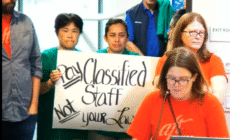
AFSCME, CSEA and AFT employees speak out for fair pay and benefits at Board of Trustees Sept 10, 2025 meeting

James’s department colleague, instructor Keira Travis, reinforced that message: 

“I just want to know that my financial situation will at least hold kind of steady. The District’s current offer guarantees that my life will get financially worse and that I’ll be distracted by financial problems. . . . I see the District spend money on anti-union lawyers who are rude and obstructive. These are bad expenditures! Invest in your people so that we can all be fully united!”9

Making improvements to our contract through strong negotiations, member participation and continuing to call out the Board of Trustees on their failures to meet state legal obligations can make a difference. 

But as we’ve now seen, more direct action will be needed to win a fair contract. Our power as a union is collective. Union members must unite to reject District offers that insult and devalue us. 

How can faculty move the needle? By choosing solidarity over silence!
Pledge now to Boycott October 8 Flex Day

Part-time faculty with questions about pay for October 8 flex day should check their union email or contact their AFT chapter chairs: 


0

0


Endnotes

  1. AFT1493 bargaining reports: https://aft1493.org/contract-negotiations-updates/

  2. “Why do faculty need raises?,” https://aft1493.org/why-do-faculty-need-raises/, The Advocate, Issue 47, Num. 2, March 2025

  3. CPI inflation calculator, https://www.bls.gov/data/inflation_calculator.htm

  4. “San Mateo California rental market trends,” https://www.point2homes.com/US/Average-Rent/CA/San-Mateo-County/San-Mateo.html

  5. “San Mateo, Santa Clara counties lead state as most-expensive markets as California’s housing affordability reaches near all-time low,” Mountain View Voice, Feb. 2025, https://www.mv-voice.com/real-estate/2025/02/13/san-mateo-santa-clara-counties-lead-state-as-most-expensive-markets-as-californias-housing-affordability-reaches-near-all-time-low/

  6. “CalPERS announces health care premiums for 2026,”  https://calretirees.org/Member-Resources/News/calpers-announces-health-plan-premiums-for-2026

  7. Sources for inflation: raw data , inflation calculator

  8. Prof. Teeka James to Board of Trustees on Sept. 10, 2025.https://smccd.hosted.panopto.com/Panopto/Pages/Viewer.aspx?id=a1ed1f6c-4fb0-4244-a6fc-b35501112e20&start=1484.611183

  9. Prof. Keira Travis to Board of Trustees on Sept. 10, 2025. video recording,  https://smccd.hosted.panopto.com/Panopto/Pages/Viewer.aspx?id=a1ed1f6c-4fb0-4244-a6fc-b35501112e20&start=1609.515381