Below are recommendations we hope to vote on today, November 15, at Skyline College’s Health, Safety and Emergency Preparedness Committee in order to bring them to the District Safety Committee according to our responsibilities outlined in our contract.
The recommendations have been culled and prioritized from data received by AFT’s recent survey of Skyline faculty. They reflect joint concerns of the AFT and CSEA bargaining groups and our collaboration.
Dec 2, 2021
We propose that the following recommendations for enhanced health and safety practices and strategies be brought to the District Safety Committee for consideration:
Per Board Policy 2.90, Chancellor provides an administrative procedures document, similar to that of Foothill College or College of Marin, that includes: a definition of each in-person campus program, service and activity (in-person indoor class, indoor sporting game, indoor theater performance, etc.); definitions of each type of visitor to campus (guest, contractor, volunteer, student, employee, etc.); and corresponding details of which health and safety rules and practices are applicable to each (matrix).
For examples, see Reference Document 1: Administrative Procedures, Board Policies & Health Screening Systems at Bay Area community College districts and Reference Document 2: District Administrative Procedures Matrix.
Reference Documents:
Administrative Procedures, Board Policies & Health Screening Systems at Bay Area Community College Districts
Foothill/De Anza District
https://foothill.edu/healthservices/covid19-health-safety/health-assessment.html: See FAQs; self-screener including FAQs for what to do if you don’t pass; information for visitors; also see Administrative Procedures with definitions: https://go.boarddocs.com/ca/fhda/Board.nsf/goto?open&id=C3KPX566B052 (Adopted June 30, revised Aug 2, 2021).
Peralta District
College of Marin (Note: Marin County has lowest COVID rates in region and highest vaccination rates)
http://www1.marin.edu/news/coronavirus-covid-19-updates-and-resources: Self screener with Vax status, health screening, employees, guests and reporting of where you intend to be on campus
Symptoms Screener link: https://mycom.sjc1.qualtrics.com/jfe/form/SV_9TxjO1YucKu6MWV
Board Policy similar SMCCD but includes volunteers: https://go.boarddocs.com/ca/marin/Board.nsf/files/C5KNLM5ECDEC/$file/BP%203507%20COVID-19%20Vaccination%20Requirements%20(NEW)%208-4-2021.pdf
Administrative Procedures with definitions: (Adopted Oct. 12, 2021) https://policies.marin.edu/sites/policies/files/AP3507-COVID-19-VaccinationRequirements.pdf
CCSF
https://www.ccsf.edu/covid-19-updates – working on, but not up, clearer communication on website that they are working with Google to use the Ready Education app
SJECCD
Administrative Procedure (Passed and last modified September 23, 2021). https://go.boarddocs.com/ca/sjeccd/Board.nsf/goto?open&id=A593S27DAB39#-
Evergreen Valley College
Check in process – https://www.evc.edu/home/safety-services Requires vaccines for visitors and guests staying more than 15 minutes
Diablo Valley/Contra Costa District
Detailed screener for students, staff, faculty, and visitors and vendors
https://www.4cd.edu/covid19/vaccine-requirement.html
Screener required starting January 2022 (Vaccinations required for guests)
On November 15, AFT and the District began negotiations for a Memorandum of Understanding (MOU) governing working conditions in Spring 2022, when the District has planned a full return to on-campus instruction and student services. In addition to being our first negotiating session for the Spring 2022 MOU, Monday was also AFT’s first time negotiating with the District’s Interim Chief Human Resources Officer Marie Billie.
AFT’s negotiations team included Joaquin Rivera, Monica Malamud and Marianne Kaletzky, while the District’s negotiators were Marie Billie, Mitch Bailey, David Feune, Aaron McVean, Joe Morello, Charlene Frontiera, and Max Hartman.
In advance of the November 15th negotiations session, AFT had submitted a full proposal for the Spring 2022 MOU that contained provisions including those below. The District responded to some provisions by the end of the November 15th session and indicated that, for other provisions, they would have a response ready by our next negotiation session on November 17th.
AFT’s opening proposal included:
The District offered responses to some of AFT’s proposals during our negotiation session on November 15th, and followed on Tuesday evening with an email response to the rest of the proposals. AFT then offered a counter-proposal to the District’s response during the November 17th session, with the District promising their next response by the beginning of our upcoming negotiation session on Tuesday, December 7th.
AFT and the District have come to agreement on the following protections for faculty:
Unfortunately, we were unable to win the continuation of FFCRA-style leave (which expired under Federal law at the end of 2020) or the reduction of each classroom’s capacity by 35%. The District also indicated they were unwilling to consider paying adjuncts for time spent preparing to teach classes that are subsequently canceled, as our current contract does not provide for prep pay. We hope to take this issue up in bargaining for our next multiyear contract.
The following issues remain under discussion:
by Eric Brenner, Advocate Editor
Reflecting the trend of community colleges throughout the state (see references below), SMCCCD enrollment has experienced major declines since the rise of the Covid-19 pandemic, which accelerated enrollment reductions that had been trending downward for a number of years before Covid. From Fall 2016 to Fall 2021 the number of full-time equivalent students (FTES) in our three colleges dropped by about 30% (from 8159 to 5734), including a loss of more than 12% in just the last year. (see chart) Fortunately, since SMCCCD (as a “community-funded” district) is funded primarily from county property tax revenues, reduced enrollment does not have a significant impact on the district’s budget. While the number of course sections throughout the district has not declined as rapidly as enrollment figures (a 9.8% reduction from 2196 sections in Fall 2016 to 1981 in Fall 2021, see chart) the ongoing reductions in sections have nevertheless directly impacted adjunct faculty assignments. The number of part-time faculty teaching in the district has declined 5.7% from 542 in Fall 2016 to 511 in Fall 2021.**
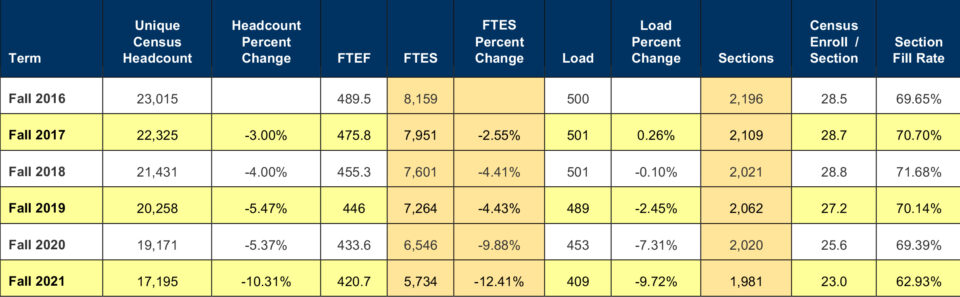
Productivity & efficiency data above courtesy of of Office of Planning, Research, and Institutional Effectiveness (PRIE), Skyline College. Special thanks to Zahra Mojtahedi, Senior Planning and Research Analyst
SMCCCD Faculty Headcount: Fall 2016 – Fall 2021
| FT Faculty | PT Faculty | |
| Fall 2016 | 338 | 542 |
| Fall 2017 | 353 | 522 |
| Fall 2018 | 362 | 556 |
| Fall 2019 | 354 | 544 |
| Fall 2020 | 354 | 515 |
| Fall 2021 | 380* | 511* |
* Note: The above faculty headcount figures from Fall 2016 through 2020 are from the state CCCCO Data Mart. The Fall 2021 figures are from SMCCCD HR Department.
The union has encouraged administrators to try to maintain the number of sections in order to provide the most options for students and thereby help prevent even greater enrollment losses. During the pandemic, smaller in-person classes also reduce the danger of spreading the virus and smaller student-teacher ratios provide greater opportunities for faculty to support individual students’ needs, especially as those needs have increased dramatically with all of the Covid-related impacts. In response, the district has agreed to allow a lower minimum number of students per section. The Spring 2022 MOU will continue to include the agreement that “All classes, whether online or in-person, will not be canceled so long as they achieve a minimum enrollment of 10 students.”
AFT 1493 wants to see the impacts on adjuncts minimized as much as possible. The following additional language, which is in the Fall 2021 MOU and has been proposed by AFT to be continued in the Spring 2022 MOU, provides some more protections for part-time faculty:
In negotiations for the Spring 2022 MOU, the AFT has also proposed that:
Adjunct faculty members who have questions or concerns about assignments, benefits or any other issues related to their working conditions should contact an AFT 1493 representative:
References to articles on California community colleges enrollment declines since the start of the Covid-19 pandemic:
Nov. 12, 2021 — Dramatic enrollment drop won’t cost California community colleges state aid but could impact adjunct faculty (EdSource)
Nov. 4, 2021 — California community college enrollment drops below 2 million students, more than previously reported (EdSource)
Oct. 25, 2021 — Community college enrollment drops worry campus leaders (Inside Higher Ed)
March 19, 2021 — Enrollment declines at California’s community colleges far greater than earlier predictions (EdSource)
December 17, 2020 — ‘Losing A Generation’: Fall College Enrollment Plummets For 1st-Year Students (NPR)
December 10, 2020 — Community colleges hardest hit as college enrollment among high school graduates falls nationally amid the pandemic (EdSource)