Monthly Archives: March 2011

Thousands rally at capitol against education cuts

by Elizabeth Terzakis,
Cañada Chapter Co-Chair

Two hundred and fifty buses full of college students from all over the state of California converged on Sacramento on March 14 for the yearly March on March in support of public education. The stakes are particularly high this year, given Governor Jerry Brown’s proposed budget, which cuts spending for state universities and UCs by $1 billion and spending for community colleges by $400 million, guaranteeing both fee increases and a reduction in services.

sactocrowdA crowd of some 5,000 stood in front of the capitol building in the pouring rain listening to speakers demand that Brown rethink his budget priorities and rescind the planned cuts. Representatives from different campuses called for the passage of the California Dream Act, an end to tax loopholes for the rich and corporations, and the opportunity to vote on an oil extraction tax—California is the only state that does not tax oil companies for extracting oil. Protesting students held signs saying “Tax the rich!” “Blame the bankers, not the teachers!” “Solidarity—from Sacramento to Madison with love” and “Support immigrant students—education for everyone!”

That this demonstration was only the beginning of the fight was made clear when a group of thirty students briefly staged a sit-in on the floor of the capitol rotunda, demanding to be allowed to enter the assembly chamber where their future was being discussed. State troopers moved quickly to block the entrance ways and keep out any additional protesters. They then told those sitting in that they would be arrested if they did not leave. The students decided to retreat, but promised to be back—and bigger.


Negotiations Update – March 2011

Your AFT Negotiating Team has been working for more than a year to hammer out an agreement with the District.  As you know, given the drastic state of funding to education, many school districts have taken drastic measures:  furloughs, salary and/or step freezes, across the board salary cuts, such as at CCSF, and in the worst cases, layoffs.   In our district, our part time instructors have experienced cutbacks to teaching loads and many have lost their entire assignments.  We have lost some excellent colleagues, and our students have lost the opportunity to work with great teachers.  What is happening to education in this country –and in our state — is shameful.

Throughout this long and still unresolved round of bargaining, we have tried to guard against any further damage to faculty and to the quality of the education we offer to students.   At this point, we are still unable to report any details of our conversations at the table because we are still working with a state appointed Mediator.  We are as frustrated as you must be, and we wish we could communicate more openly with you, but the rules of Mediation dictate that we cannot share any specifics — yet.   We will continue to fight for the best possible agreement we can achieve.  We are not giving in or giving up.  Thank you for your patience and your hard work.  As soon as we are able, we will send out an email communication and bring all of you into the conversation.  Meanwhile, let your union reps know of anything going on in your workplace that is of concern, and hang in there. Let’s not let California become another Wisconsin.

In unity,
Joaquin Rivera, Chief Negotiator; Katharine Harer; Victoria Clinton & Sandra Raeber-Dorsett, Part-Timer Representatives

President’s Letter – March 2011


Attacks on collective bargaining undermine a basic right for employees: a voice at work

by Monica Malamud, AFT 1493 President

For several weeks now, we’ve been hearing the grim news about the Wisconsin Governor’s scheme to strip public sector workers, including faculty, of their collective bargaining rights. Unfortunately, similar legislation has been introduced in other states as well.

On the surface, proponents of these initiatives to do away with unions say that flexibility is necessary in order to deal with the current deficits. But the existence of unions and their right to negotiate does not stand in the way of finding solutions to the economic crisis. In fact, through the collective bargaining process, public employee unions in Wisconsin have offered concessions about their salaries and their contributions towards health care costs, in order to help the state deal with the budget deficit. Unfortunately, for Wisconsin Governor Walker this is not enough. Which points to the real motivation behind his proposal to disband unions, and similar proposals in Ohio, Florida, Michigan and New Hampshire: the goal is not “flexibility”, but rather absolute power for employers to make decisions unilaterally, without ever negotiating with employee groups.

Without collective bargaining employers have unlimited power

Collective bargaining does not give extraordinary powers to unions. Collective bargaining means that agreements are hammered out collaboratively between two groups: employers and employees. Those who would like to do away with collective bargaining say that unions have too much power. They’re actually right: in their opinion, unions have too much power, because any power that the union has means that employers cannot do as they please, so they would like to silence the voice of employees and give employers all of the power. With unions and collective bargaining rights, the power is fairly shared among stakeholders and the two parties must reach agreements, usually through compromises.

When compared to other countries, progress on collective bargaining rights in the United States has been slow but steady. Union membership in the public sector has been rising. We must continue to move forward, not backward, for the benefit of working people—the majority of the population. In fact, according to recent polls, a majority of Americans are opposed to the weakening of organized labor and the erosion of collective bargaining rights. The current attack on workers’ rights to form a union and to bargain collectively cannot be tolerated. Revoking these rights would erase decades of real progress for working people. Let’s stay informed and do everything we can to ensure that unions can continue to protect workers and be a force for social progress.


An interview with a Madison teacher


A personal view of Wisconsin teachers’ fight for collective bargaining rights

By Teeka James, AFT 1493 Co-Vice President, accompanying photos by Jennifer James

My sister and brother-in-law are secondary school teachers in the Madison Metropolitan School District. Jenny teaches art at an elementary school, and Bill teaches history at a high school. They also have two children: Tegan Anne, a kindergartner at a K-2 school and Henry, a fifth grader at a K-5 school. When I finally caught up with Jenny, she was parked in her driveway with her six-year-old daughter asleep in the back seat. They had been downtown for over six hours exercising their right to peaceably assemble and petition the government. The peaceably assembling part went well; petitioning the government, not so much. While Tegan slept, Jenny told me about her experience on the front lines of the Wisconsin public workers’ struggle to retain collective bargaining rights.

Jenny: It’s been nuts around here. I’ve been dragging the kids down to the capitol everyday this week. It’s been really cold, too, so there’s been lots of whining about cold feet.

mad-aboutfreedomTeeka: What do the kids think about what’s going on?

Jenny: Tegan loves it—she loves the drumming and the chanting! The first Wednesday—the first day I called in sick—Tegan and I went down to the capitol, and her teachers were there, too, so she was really excited to be there with them. Henry’s trying to figure it all out, so we’re talking about it at home pretty much nonstop. The district ordered us to not talk about it at all with the kids, so I’m not, but lots of kids have been going down to the capitol with their parents, and they’ve seen me and their other teachers down there, so the kids will say stuff to us, ask questions. It’s a balancing act to figure out how to deal with it. One kid in my classroom made a sign to take to the rally that afternoon.

Teeka: What’s the climate at your school? Are most teachers calling in sick?

Jenny: Well, yes and no. The teachers are not divided, which is good, but it’s really hard to keep up with it all; everything’s changing so quickly. When it all started and MTI (Madison Teachers Incorporated—the local union) called for the sick out, a lot of people didn’t know what to do. Bill and I went to work because we weren’t sure what it all meant—you know, what would happen if we called in sick, what to do with the kids. We wanted clarity. At my school, the staff met after school and decided to act together, but agreed that everyone would do what felt right for them and no one would pressure anyone else to demonstrate or not. Lots of us called in sick the next two days of that first week.

Teeka: So what happened at school? Did the district dock pay?

Jenny: Well, yes they say they are going to. Anyone who called in sick on those days has to show a doctor’s note; otherwise, they’ll lose a day’s pay.

Teeka: Do you normally have to show a doctor’s note when you call in sick?

Jenny: No! But there’s another problem (one of many!): the kids have missed several school days, which the district is going to have to figure out how to make up. They had only planned for one snow day, so I don’t know what they’re going to do. The thing is, to add days, the teachers will have to teach the kids—and so far the word is that the district will not pay the teachers for those days. Plus, we got docked for the sick days . . . people are really mad.

Teeka: Did Bill’s pay get dmad-missartclassocked, too?

Jenny: Yes. Everyone’s did. Once people started calling in, the principals were ordered to check staff in twice a day. But it really depends on your principal what’s actually happening. My principal has us check in twice a day, but Bill’s is only making staff check in first thing in the morning. So Bill’s been checking in and then going down to the capitol at lunch time.

Teeka: So is anyone calling in sick anymore?

Jenny: I think some are, but most of us are teaching during the day and then dashing down to the capitol after school. MTI is trying to divvy up the district so we can keep a teachers’ presence down at the capitol but not have everyone getting burned out and impacting the kids too much. So each day different schools are designated to go to the rallies. MTI is sending out emails and all that electronic stuff telling us where to congregate, meeting points and times, that sort of thing. There’s a constant list of speakers.

Teeka: So what’s it like down at the capitol?

Jenny: Considering how fast everything’s had to happen, it’s pretty organized! At first the idea was to occupy the capitol to try to stop the votes from taking place. Some people did get in initially and stayed there for a few days—people were bringing sleeping bags, food, all sorts of stuff to help them. Early on at Bill’s school, when Jesse Jackson spoke at the rally, that morning he walked the teachers into work at East High School and then at lunch time, 800 students walked out and marched with Jesse Jackson from the school straight up East Washington all the way to the capitol—about two miles!—and occupied the rotunda. Bill walked with them during lunch and then went back to work. That was the beginning. The next day the sick out started. Bill’s school is mostly low income and African American; it was great to see the kids be such strong leaders in all of this.

Teeka: What’s the scenmad-article1e at the capitol now? Is it still occupied?
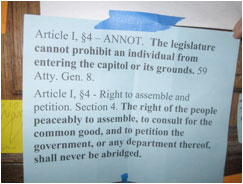
Jenny: Well, I’m not sure. I think some people might still be in there, but the governor closed the capitol building to the public, so we were all stuck outside. One issue is that folks are saying it’s illegal to close the capitol to the public. Walker called in all sorts of law enforcement, but of course many of them—especially the Madison cops, are with the teachers and the rest of the workers, so they refused to arrest people who were occupying the building. At one point, the Democrats from the Assembly brought their office desks outside onto the capitol lawn, saying that if Walker was going to close the building to the people that they would bring the government out of the building back to the people. It was pretty cool!

Teeka: What do you think will happen, Jenny.

Jenny: Well, the rumor at the capitol is that Madison will go on general strike. And if the city workers strike, MTI will be right behind them. If that happens, Bill and I will definitely walk. I think most of our staff will, too. But, what’s really going to happen is lots of people are going to lose their houses and their jobs.

Teeka: Have you already had furloughs and whatnot so far?

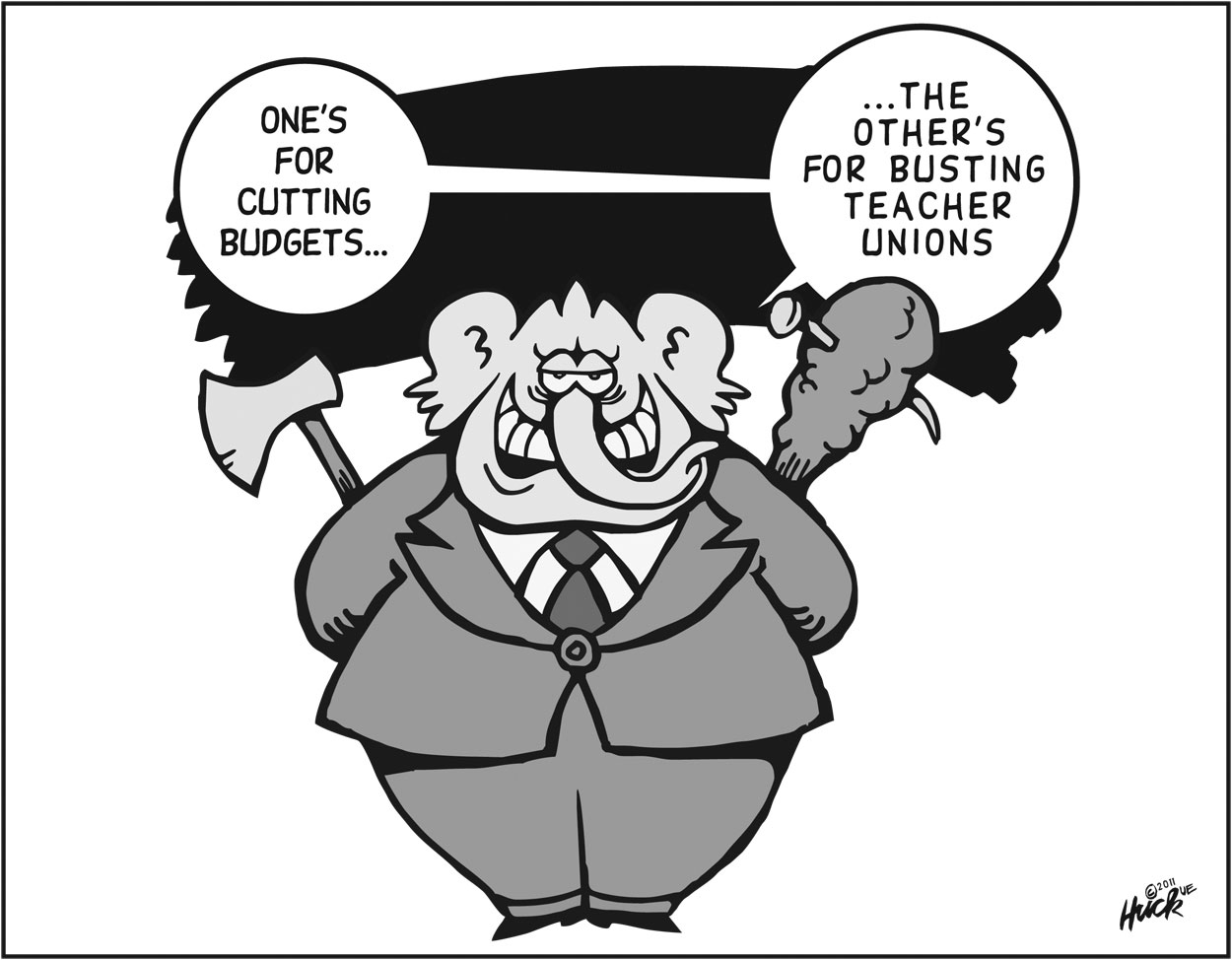
Jenny: No, we haven’t. And get this: the teachers voted and MTI had agreed that we’d put in more for health care and pensions in exchange for keeping collective bargaining rights. But Walker turned it down. Walker wants to up class size, get rid of art, music, PE, technology—all the stuff Madison’s been able to keep somehow. This is so totally not about money. He just wants to kill the unions.

Teeka: What would those pay cuts look like?

Jenny: I don’t have the details here, but I think Bill and I would each have to pay $500 per month total. That means we’d take home $1,000 less each month. I’m not sure how it all would work out with taxes and all, but that’s about a quarter of our total take-home pay.
cartoon-bustingteachersunions-webTeeka: Holy cow! That is a huge cut!

Jenny: I know. It’s just incredible! The MTI crisis committee is meeting tonight. A lot will depend on how the vote goes in the Assembly. What is so crazy to me is that it seems like the government has forgotten about the kids. Who is it that Walker thinks is going to want to be a teacher in Wisconsin after all of this? It’s just heart breaking. Tegan asked the other day why the governor didn’t like music. Henry answered her and said it was because his heart was all shrunk up like the Grinch’s!

Teeka: Well, there you have it. Spoken from the mouths of babes!

Jenny: I know. They see what the adults’ priorities are. They get it.



From the Part-Timer’s Perspective – March 2011


The New Faculty Majority and SB 114

by Margaret Hanzimanolis,
AFT 1493 Part-time Faculty Organizer

Ed. note: This is the inaugural installment of “From the Part-Timers’ Perspective,” which will be a regular Advocate column by Margaret Hanzimanolis, AFT 1493’s new Part-time Faculty Organizer.

The numbers are striking: Over half a million contingent faculty nationwide, tipping into the majority four or five years ago. In one of the wealthiest college districts in America, the numbers are, if anything, even more surprising: SMCCD is at a historic high point in its reliance on part-time faculty: 758 part-time faculty are currently teaching alongside 293 full-time faculty. While around 72% of the faculty in the district are employed on a part-time basis, a smaller proportion of classes are taught by part-time faculty members, currently 37%.

In what other sector do part-time workers constitute the majority? No other public sector of the economy is so heavily staffed by temporary, part-time workers. You won’t find the first half of a 9th grader’s class taught by one part-time faculty and the second half by another. Your bus drivers, IRS personnel, Department of Motor Vehicles employees and college administrators are rarely temporary and virtually never part-time. To try to understand this labor anomaly, one must imagine college classes as “piece work”—and accept that what happens, what is meant to happen, inside the college classroom led by a part-time faculty member is, in some crucial ways, split off from the rest of the institution.

This sort of fragmentation is deeply damaging. When faculty members have weak institutional connections, when their class is a “piece” of work that is bounded by the start and the end of a class period, the educational transaction is damaged. Building strong cohorts of students, who are involved in and supportive of one another’s success, and led by faculty members whose institutional roots are deep, and who are fully integrated into all of the readiness and success support programs, is the best way to ensure high student completion rates. We need faculty to be strongly invested in the entire sweep of a student’s educational experience—from first contact to successful transfer or associate’s degree—not just in a semester-long set of discipline-specific outcomes.

This shift —from a faculty with strong institutional and student body connections to a faculty with weak institutional connections —has happened for obvious reasons: it’s cheaper and it’s more convenient for administrators to deal with a weakened faculty. Part-time faculty typically work on more than one campus or have other work jobs or family responsibilities, and usually can’t involve themselves in campus or departmental committee work, curriculum revision, technological innovation, advising and the informal contact students so urgently need, and a growing burden of administrative tasks overwork full-time faculty so that their institutional influence in program innovation, revision, and curriculum is flattened out.

But is it really cheaper? No, actually not. The administrative frictions of the constant turnover of part-time faculty, the keys and contracts, and last-minute schedule changes are costly. The low completion rates that are strongly correlated with reliance on an enormous, largely un-integrated faculty cadre, will emerge (once someone finally begins to track and analyze these kinds of data sets) as the most costly downside to the practice of the casualizing of academic labor at community colleges.

If community colleges are going to be funded, as many suggest will happen, on the basis of completion rates, the existence of these very weak connections between the large and growing part-time faculty cadre and the institution that has kept this enormous group of people at a deliberate distance from its core mission, will work strongly against those districts, campuses, departments and divisions that rely most on part-time faculty, and will most severely affect those institutions whose part-time faculty are most marginalized, most unfairly-compensated and most demoralized.

What hope is on the horizon? If we accept that the full integration of part-time faculty into the community college institutional culture is the key component to boosting completion rates, the most important initiative on the table now is SB 114, introduced by Senator Leland Yee, which would require parity in salary between full-time and part-time faculty and regularize the pension calculation formula, which currently disadvantages part-time faculty members working at more than one campus. (See article on next page.) This single initiative would go a long way towards fostering more meaningful institutional integration of part-time workers, the single largest drawback to this antiquated, unworkable two-tier system. More on SB 114, part-time professional development, national part-time and contingent faculty news, highlights of part-time contract provisions, re-employment preference lists, overload practices, opportunities for union involvement, SDI, unemployment compensation, health coverage in the coming months!