Monthly Archives: May 2025

Faculty and students come together for International Workers’ Day 

By Rika Yonemura Fabian and Jessica Silver-Sharp

Responding to the most repressive political climate we’ve seen in many of our lifetimes, students and faculty union members came together in solidarity for rallies on International Workers’ Day at both Cañada and Skyline Colleges. The focus was on the range of rights and freedoms currently under attack from the federal level all the way down to our local District level, with a particular emphasis on faculty solidarity with international student struggles and calls to action for administrators to enshrine protections for students and faculty alike. On view was a core principle of the labor movement: “an  attack on one is an attack on all.”


Cañada College

At Cañada College, where AFT faculty organized the rally, the necessity for the action was made clear early on when the event was all but prohibited by the College. Organizers overcame a variety of hurdles including having their calendar event posting denied and facilities requests (microphone, table, pop-up canopy) canceled. Communications intended to silence employees critical of District inaction to protect vulnerable students have also been received from the administration. Ironically they erroneously cited as their reason as District Board Policy 2.30 on Political Activity, in ignorance of the more relevant Board Policy 3900 (Speech: Time, Place and Manner) which permits faculty rallies of this type: “The Board of Trustees recognizes that fostering free speech and encouraging the broad expression of diverse views are essential to the District’s goal of offering a rich educational environment.” 0

Faculty members Michael Hoffman and Camille Kaslan kicked off the rally at Cañada College, May 1, 2025.


To a Cañada College crowd of more than 50 students and faculty, instructors from across the disciplines took to the megaphone to share critical perspectives on protecting our rights in the face of authoritarianism. Colin Ehara (Ethnic Studies) called out the importance of Ethnic Studies in community college general education patterns; Doniella Maher (English) spoke on reproductive freedoms we cannot afford to lose for ourselves, our students, and our children; Elizabeth Terzakis (English) explained the political responsibilities of institutions of higher education to take a stand for what’s right; Michael Hoffman (Mathematics) connected academic freedom with the attack on international students advocating for a free Palestine; Helena Almassy (Mathematics), the daughter of immigrants, spoke about the importance of protections for these communities; and Camille Kaslan (Chemistry) reminded us of the need to organize and build up our collective voice to hold both College and District administrators accountable for our community’s safety and well-being. Student speakers included representatives from Students for Justice in Palestine (SJP) and the Black Student Union (BSU). The event concluded with a community singing of the Civil Rights era anthem, “Ain’t Gonna Let Nobody Turn Me ‘Round.”


Skyline College Coalition Organizes

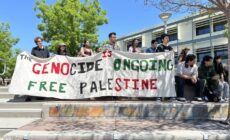
Students for Justice in Palestine display their banner, Cañada College, May 1, 2025

At Skyline College, the rally was organized by a coalition of community and student groups with a long-standing history of collaboration on campus: Students for Justice in Palestine (SJP, Skyline), Myanmar Student Union (MSU, Skyline College), Anakbayan Daly City, Sexualty and Gender Aliance (SAGA, Skyline), and Political Action and Literacy (PAL, Skyline). MSU in particular demonstrated their organizational strength to make the rally a success. 

With AFT’s Executive Director, Chet Lexvold, emceeing the rally, at the height of the event 80 to 100 people occupied the space between Buildings 6 and 7. AFT faculty speakers including Janice Sapigao (English), Mustafa Popal (History) and Mick Song (AFT Skyline Chapter Chair, Biology) brought their perspectives to the rally along with students, expressing the needs for joint struggles for queer, immigrant, and racial justice. As one student speaker explained, 

“Student Solidarity is working class solidarity is queer and gender solidarity is race and immigration solidarity – ultimately, we are all bound in the struggle by the same oppressive systems of capitalism, colonialism, imperialism, and white supremacy.” 

Other speakers called out the recent confusing responses by the District to potential immigration enforcement activities on campus. Professor Popal denounced recent District messaging encouraging employees to essentially do nothing for their students in the case of an ICE raid, interpreting the District’s message to say that if individual faculty stand up for students, they can’t expect District support. He called out the gap between District words and actions on the issue. 


Professor Sapigao concluded the rally with a call to action:

“Today I call on my colleagues – those of us with degrees and the privilege of a classroom or an office or a full-time job – to put our bodies on the line for our students. To stop discouraging them from going out in public, and to encourage them to gather in the light and not be afraid in the shadows; if they are going to an event, go with them to protect them. And if they want to say something or ask a question, amplify their message. Listen to their voices that live in you.” 


Petition Circulated

At both rallies, students, faculty and community members signed a petition, “BAY AREA COMMUNITY COLLEGE FACULTY DEMAND PROTECTIONS AGAINST TRUMP ADMINISTRATION REVOCATION OF STUDENT VISAS.”Jointly initiated with the Foothill-De Anza Faculty Association and now in coalition with City College of San Francisco Faculty Union (AFT 2121), the petition came about in response to the sudden visa revocations of ten international student visas at both campuses.

As AFT 1493 wrote to faculty on April 21, 

“We are expressing our plea as a united force between the two faculty unions, as we’ll be linking with other unions in the Bay Area and across the state in the weeks ahead to persuade our Districts that they need to support our students first in order to support our institutions.” 

Readers are encouraged to take action and sign this important petition today. 


The Time Is Now

By Tim Shively, President of the Foothill-De Anza Faculty Association

“First they came for the Communists, and I did not speak out—because I was not a Communist. Then they came for the Socialists, and I did not speak out—because I was not a Socialist. Then they came for the trade unionists, and I did not speak out—because I was not a trade unionist. Then they came for the Jews, and I did not speak out—because I was not a Jew. Then they came for me—and there was no one left to speak for me.”– Martin Niemoller, “First They Came”


Martin Niemoller’s words are perhaps more germane today than at any time since he wrote them in 1947 post-war Germany.  In today’s America we are at an inflection point as a society where our bedrock principles of morality, ethics and law are being fractured, and this is particularly evident in the field of higher education, which has been under assault by the Trump administration.  Recently, this has manifested in the termination of international student visa status, wherein some 1500+ students (that we know of) around the nation who had been granted entry to study here in the US primarily on F-1 status last month had their status unceremoniously revoked with little explanation from the Department of Homeland Security which monitors this status.  In fact, neither the nine students at Foothill-De Anza and one in the San Mateo Community College District nor their institutions were initially alerted to this development.  While this “termination” stopped short of initiating their removal from the country, and the status of most of these students was ultimately restored, that is small comfort to those students who have already left the country, probably fearful of the headline grabbing stories of students being pulled off the street by masked agents, shipped to deportation centers in far flung states and held for weeks without due process.  


This led to the San Mateo Federation of Teachers [our union, AFT 1493] reaching out to the Foothill-De Anza Faculty Association and asking for our participation in launching a petition they had drafted in support of these students.  The City College of San Francisco Faculty Union also got on board, and collectively we were able to gather over 300 signatures from faculty, students, staff and community members.  


While this show of support was greatly appreciated, and the signatures were ultimately submitted to our Districts along with requests for further discussion about the petition’s demands and how our Districts could better support these students, I have also found myself wondering what could have made it a more robust show of support.  As I shopped the petition idea around my campus, other Community College districts in the Bay Area and  around the state, there seemed to be a general lack of urgency among much of the populace.  Not that individuals wouldn’t sign a petition if was put right in front of them, but that they and their constituencies don’t seem to feel really…driven to do so.  


To some degree, this inertia seems duplicated at the District level.  My Chancellor has been very active lately encouraging other CEO’s to join together to defend themselves against the punitive and vindictive actions of the Trump administration.  There is in motion an emerging “pact” among CCC’s approximating that which has evolved between the “Big Ten” Universities nationally.  And in our conversations, my Chancellor and I have shared the difficulties (as well as the successes) in organizing disparate institutions into alliances that both have teeth (e.g. the sharing of information and resources) and can be replicated as more institutions recognize the crisis we are in and that “sheltering in place” as well as outright capitulation are not viable strategies moving forward (witness Columbia University).  At some point, we also need to develop not just horizontal solidarity within the groups that we operate, but vertical connections between the Executive level, the faculty, staff and students of our institutions and the surrounding communities.  That is when we will really have developed a strong presence that will allow us to push back and not be dismissed.  


For me, I can really only speak about CCC faculty unions.  While perhaps there is a certain insularity in the fact that we each represent only our own bargaining unit, and that each local has encoded in its individual contract with its District the rules and regulations they work by, I’d like to think we can operate and engage in collective good beyond those boundaries.  That we can use our power and privilege to empathize with and support more at risk peoples and groups even if we are not directly affiliated with them.  I think the fact that the San Mateo Federation of Teachers stepped up on behalf of the one student whose visa status was threatened is testimony to that.  So let’s reach out, beyond our comfort zones, and get everyone involved, before it happens again, and likely worse. 


President Shively speaking to SMCCCD Board of Trustees, April 30, 2025

Our response to such attacks needs to be much more public, so that the entire citizenry, not just community college students and employees, are reminded on a daily basis of how this imminent threat to international students could be easily expanded towards domestic “undesirables,” such as unions, our LGBTQ+ communities, and those of non-Christian faiths, to name a few potential targets. And the California Community Colleges’ Chancellor’s Office needs to step up its game.  To date, it has offered very little commentary–at least publicly (nothing on their website, for example)–and there does not seem to have been much if any collaboration with our state’s other higher ed systems. It may be something of a cliché, but it is truly only together that we stand a chance of making it through this storm.


Editor’s note: AFT 1493 extends its thanks to President Shively for standing in solidarity with us at our April 30 Board of Trustees Meeting and for addressing his important comments to our Board. 


The One Faculty Movement . . .

. . . and the Struggle for Economic and Worker Justice for ALL Faculty

By Tamara Perkins

A movement is growing throughout California community colleges as faculty members rally around the vision of One Faculty — a unified, equitable system that benefits all faculty. Born out of a resolution passed by the  California Federation of Teachers State Council in 2022, and driven by the resulting statewide One Faculty Task Force, this movement aims to overhaul long standing structural inequities that have plagued faculty and eroded unity and morale for decades.

The core idea is simple yet transformative: all faculty—full-time and part-time—should experience the same employment and hiring processes, as well as compensation schedules and benefits.

“The One Faculty Task Force is a movement to make the kind of changes that frankly we’ve needed for decades,” stated One Faculty Task Force Tri-Chair Linda Sneed. They have laid out the blueprint in CFT’s Vision of a One Faculty future.

These ideas aren’t new; many were suggested in a 2014 anthology on the unified model that calls for an end to the “two-tier system” in higher education. We seem to be in a synergistic moment, not just among part-time faculty, with a rising interest and belief in doing right by students and faculty to strengthen higher education in America.     

In California, versions of several of the “one tier” ideas have been discussed or implemented piecemeal—such as AB-1690, signed into law by Jerry Brown in 2016, which provided employment protections for part-time faculty including rehire rights, and the recent legislation AB-190, which funds health insurance for part-time faculty. “We still have these structural inequities that harm everyone in the ecosystem,” Sneed observed. The One Faculty movement is gaining momentum because it addresses deep-rooted inequalities.     

CFT’s One Faculty Task Force has achieved consensus in its vision and developed working groups to make progress on Phase 1 of its strategic plan. CFT has also sponsored AB-1028, a bill authored by Assembly Higher Education Committee Chair Mike Fong, to afford part-time faculty due process rights and greater job security. CFT is committing staff and other resources to further all aspects of the strategic plan.

All faculty could benefit! 

A fairer, more just system will take nothing from full-time faculty but the unreasonable workload so many experience, as more faculty engaging in governance and committee work, colleagues’ performance review processes, program review, accreditation, and other essential faculty functions will relieve some of the burdens shouldered disproportionately by full-time faculty. The Task Force hopes full-time faculty will see this as a social justice issue, recognizing that an injury to one portion of the faculty body is an injury to all. Our colleges and districts will be stronger with a more unified faculty who share interests and job responsibilities.

The One Faculty Movement envisions a future where faculty are valued equally, regardless of how many classes they teach or hours they work to serve students. At its heart, the One Faculty movement is a call for collective action toward fairness, equity, and unity among faculty. Frequently asked questions are answered here.


Tentative Agreements Reached by AFT around Key Contract Proposals

By Jessica Silver-Sharp & Monica Malamud

In the last couple weeks our union has reached tentative agreements on three key provisions of our contract. 

Informal Complaints and Formal Misconduct Investigations (Article 23)

This was an article that the District sunshined (brought to negotiations), and after the District essentially accepted our previous counter except for some minor language edits, we informed the District we are ready to reach a tentative agreement (“TA”) on this article.

Grievance Procedure (Article 17)

AFT informed the District that because they (finally) agreed to binding arbitration for our grievance process, we are ready to reach a tentative agreement on this article! Binding arbitration guarantees faculty a neutral third party decision maker as the final step in the grievance process, consistent with almost every other community college in the Bay Area. 

Reasonable Accommodation (Article 25)

This article will now include a requirement for the District to respond within ten days to a status update request from the faculty member seeking accommodations.


Observe Bargaining this Summer! 

By now you’ll have probably seen our union’s call to members to participate in bargaining (see “Turning the Tables with Strategic Participation in Bargaining” in the previous issue) with the goal of winning a fair contract expediently. If you haven’t yet had an opportunity to drop in and observe a live session for yourself, it’s not too late: negotiations are expected to continue throughout the summer. You can sign up for all four slots in June or pick and choose:   

Thursday, June 12th @ 12:00- 4:00 pm
Thursday, June 26th @ 12:00- 4:00 pm

During the Spring semester forty faculty members volunteered their time on Friday afternoons to show up, union zoom backgrounds blazing, and support AFT’s negotiations team, hear our union’s and District’s proposals for themselves, and participate in the development of counter proposals during AFT caucus time. 


Together we are stronger! 

Questions? Reach out to Chet Lexvold, AFT’s Executive Director: lexvold@aft1493.org


FACULTY SPOTLIGHT: Marc Gottlieb, College of San Mateo

By Jessica Silver-Sharp

Last month we heard from our local’s longest serving union member Marc Gottlieb, adjunct faculty instructor in CSM’s real estate program. Marc joined our union back in 1973!  

Professor Marc Gottlieb, CSM

He reported: 

“I have just been recognized and (greatly!!) honored by this wonderful new award (“Advancing Real Estate Award”) via the California Community Colleges Chancellor’s Office/ Real Estate Education Center….for all CCC Real Estate faculty in the State of California (116 full community colleges plus several dozen CC satellite campuses and centers)….”

“While it may not quite be a Nobel Prize, this is a very prestigious award and one that any of several other California Real Estate professors certainly warranted for their achievements. And besides, the Nobel Committee does give out numerous awards every year, while this award is a 2025 One-of-a-Kind honor.” 

I interviewed Marc to congratulate him on behalf of AFT and thank him for his more than 50 years of membership including regular attendance at membership meetings. I asked what had kept him coming to union meetings all these decades? He explained that it was his desire to stay informed but also to support our union in “any ways we can use” him. Not wanting to talk about himself, he quickly shifted our conversation back to his primary passion – real estate education. He explained in depth that most people don’t understand how extremely lucrative careers in real estate can be for our students who complete the program, especially in the Bay Area.

Just before The Advocate went to press, Marc also shared some last minute news he’d received from the College of San Mateo: “Congratulations! You were honored at the recent Division End-of-Year awards with the ‘Outstanding Adjunct Award’ voted by your peers!”

AFT 1493 greatly appreciates that Marc regularly shares news with our local on wide ranging issues related to California community colleges and faculty. In our conversation, he also offered a range of ideas for ways our local could better connect with Peninsula media outlets of all sorts to more strongly get across our messages to our community and tax payers. 

His message to us — “THANK YOU for all support and encouragement — and for all YOU do!” is one we’d like to send right back to him. Congratulations, Marc!