Monthly Archives: May 2020

AFT 1493 MAY DAY 2020 RALLY: WATCH ALL OF THE SPEAKERS & PARTICIPANTS

Over 120 SMCCCD faculty, staff, and students joined a Virtual May Day rally to discuss the impact of the COVID crisis on teaching and learning conditions and the need for fair compensation and for pay parity for part-time faculty. Attendees wore AFT “Red for Ed” T-shirts, sported a custom AFT backdrop, and flashed signs reading, “fair contract now!” or “part-time parity now!” Trustees Richard Holober, Karen Schwarz and Dave Mandelkern, newly-appointed CSM Chancellor Mike Claire, Pacifica Mayor Dierdre Martin, and Assemblymember Mark Berman were also present. [Read the full Advocate report on the rally.]

Click on links below to watch all of the speakers and comments from attendees:

•  Introduction by Moderator, Tim Rottenberg, Skyline College Adjunct Government/Econ. Instructor

•  Skyline Professor of History Rosemary Bell framed the discussion with a look back at the history of the May Day holiday that became International Workers Day. She moved to the current day crisis for working people and focused on the faculty contract in our district by asking a series of questions, including: “Why should those who give 110% every day not be compensated fairly for their work?”

•  Attendee comments following Rosemary Bell’s presentation

•  Skyline Professor of Economics Masao Suzuki said that the transition to online instruction was the hardest six days of his career. As such, he argued for an extension of the AFT MOU on Emergency Action due to Coronavirus Pandemic as long as “forced distance education” is our reality.

•  Attendee comments following Masao Suzuki’s presentation (including comments by Assemblymember Mark Berman)

•  CSM Adjunct Assistant Professor of Economics Ali Shokouhbakhsh shared his experience struggling to buy a condo in the South Bay Area for the last 8 years. With adjunct wages set at 60-70% of a full-time employees, little to no job security semester to semester, and banks “know[ing] what ‘adjunct’ means,” he found himself chasing skyrocketing prices.

•  Attendee comments following Ali Shokouhbakhsh’s presentation

•  Attendee comments following Steven Lehigh’s presentation

•  AFT President and Chief Negotiator Joaquin Rivera, thanked faculty for their support and pledged to “continue our fight for a fair contract, particularly in areas around workload, part-time parity and fair compensation.”

•  Chancellor Michael Claire said he’s “confident we’re going to be able to settle this contract,” acknowledging that “on our side we kind of needed a fresh look” and so the District has brought in an outside negotiator to “help all of us get through this next phase.”

•  Pacifica Mayor Dierdre Martin thanked the organizers for being invited and wished them good luck in settling the contract
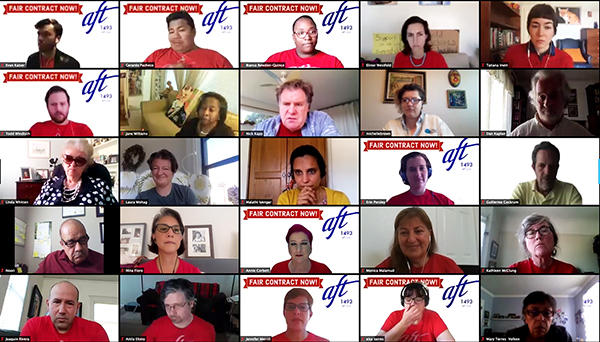
25 of the more than 120 attendees at AFT 1493’s May Day 2020 Virtual Rally

UNEMPLOYMENT INSURANCE DURING THE COVID-19 PANDEMIC

All part-time faculty should remember that you are eligible for unemployment compensation benefits over the summer and during the winter break, unless you are working another job over the summer or between semesters and you are earning more than your unemployment grant would be. During the pandemic, the Federal CARES Act brings additional benefits.

READ UPDATED INFORMATION FROM THE CFT ABOUT UNEMPLOYMENT AND OTHER CARES ACT BENEFITS.

———————————————————————

As soon as you give your last final exam, you should contact the Employment Development Department (EDD) and file a claim, or reactivate the one you have from winter break (if you applied then). If it is a new claim, you will have a one-week waiting period before benefits start, so do not delay. You can also claim for the period between regular term and summer school. When filling out your weekly forms, don’t forget to claim paid flex days.

When applying, tell them about all your jobs, since your benefit is based on all your income over the previous year. When they ask if you have a job to go back to after summer or winter break, answer: “Not with reasonable assurance. I only have a tentative assignment contingent on enrollment, funding and program needs.”

This is important: Do not just tell them that you have an assignment for next semester or you will be disqualified. According to the Cervisi decision of the State Court of Appeals (and the Ed. Code), part-timers, as a class, do not have “reasonable assurance” of a job and hence are eligible for benefits between terms. If questioned further, mention the Cervisi case.

Be sure to fill out all job search forms correctly, and appear as directed in person or by phone or mail. You should not have any problems, but if you are denied for any reason, contact Paul Bissember in the AFT office (bissember@aft1493.org) as soon as possible and the union will advise you on how to file an appeal. Don’t be reluctant to file. This is your right, not charity!

May 2020 Advocate: Face-to-face teaching must remain the core of higher ed.

ONLINE EDUCATION

Face-to-face teaching must remain the core of higher ed.

by Rika Yonemura-Fabian, Skyline AFT Chapter Co-Chair

The sudden switch we all made in March to remote education has turned the entire District inside out.  Just a few months ago, about 80% of our classes were taught face to face.  In this new-to-most-of-us online environment, we’ve been focusing on the question in front of us: “Are students learning?” Yet we also need to consider how this might forever alter the teacher-learner relationship that is the bleeding heart of education. How will this emphasis on online education erode faculty autonomy and discipline expertise, both of which are necessary to ensure we don’t become degree mills?

One Skyline faculty member recently articulated his concerns in an email correspondence:

One of the concerns is faculty will face additional pressure to convert more of our face-to-face courses to fully online.  First, the fact that all courses at all campuses are now being taught online might be taken as “proof” of effectiveness even if faculty doubt that online courses can ever match classroom experience, no matter how “good” the technology is.  Second, face-to-face sections will not be able to compete with online sections offered by other campuses if these now become widespread.  Third, if they do become widespread, the College itself will lose enrollments and courses unless it adapts to the trend.

Faculty have repeatedly observed that Deans suggest converting a course online when the enrollment is low. A recent strong push for fully online degrees at Skyline College (“Skyline NOW”) seems to show that this is part of a greater theme: Online classes increase “efficiency.” We don’t accept the premise, but even if it is true, we reject the notion that efficiency is the goal of education. We respectfully submit that learning is our purpose.

The Skyline faculty member’s analysis of the current crisis extends to an examination of the identity of higher education and educators. He has experience with Canvas and is comfortable using it for his classes. He finds it to be a well-designed and useful tool, and definitely a big improvement from WebAccess.  But that’s all it is, he emphasizes: A tool. The technical and design aspects of migrating course materials onto a learning management system is not the same as teaching the materials– a distinction that administrators, who are not working directly with students, seem oblivious to. Knowing how to utilize a tool is only one of many elements that makes good craftsmanship. However, what provides her/his expertise is not the tool itself, but the human being. All the training on how to use an LMS has been helpful to manage the emergencies, but we need to talk about how to better apply our accumulated expertise in teaching, classroom facilitation and all the emotional work we do with students to the technological tools.

What we hear in the concerned faculty member’s email is a manifestation of what some of us believe should be our unified message to the administration and those who are running the system. Face-to-face teaching by a subject expert should remain the irreplaceable core of higher education. Watching videos, going to chat rooms, listening to recorded audio, etc. can be useful supplements, but are not a substitute. And students have the right to quality, human interactions as the medium of learning. This is what contextualizes knowledge for students: meaningful relationships with the teacher and with their peers. Distance Education has its place—but as a supporting role.


May 2020

View full May 2020 issue (pdf)

In this issue: