Monthly Archives: April 2014

May 2014 Advocate – Board resolution expresses concern about ACCJC


ACCREDITING COMMISSION

Board passes resolution expressing concern about ACCJC’s “overly punitive” sanctions and calling for “a more collaborative spirit”


Our District Board of Trustees unanimously passed a resolution, at their March 26th meeting, that expressed “its deep concern over the adversarial nature of the relationships between Accrediting Commission for Community and Junior Colleges (ACCJC) and many of California’s community colleges and the excessive and overly punitive nature of sanctions” and urged the Commission to “take meaningful steps to begin developing a more collaborative spirit in its work with the California community colleges and that it amend its accreditation standards to remove the regulatory and compliance issues and re-focus the standards on student access and success.”  The Board is sending the resolution to their fellow trustees in the 71 other community college districts in the state as well as to the State Chancellor’s office, the U.S. Department of Education and to ACCJC. The complete resolution follows below:

Resolution Regarding the Accrediting Commission for Community and Junior Colleges

WHEREAS, the United States system of regional accreditation has been well-established and has traditionally provided essential guarantees of quality in America’s post-secondary institutions since the 1950’s; and

WHEREAS, the goal of accreditation, according to the United States Department of Education (USDE), “is to ensure that education provided by institutions of higher education meets acceptable levels of quality”; and

WHEREAS, accreditation, as interpreted by Accrediting Commission for Community and Junior Colleges (ACCJC), has little to do with the quality of instruction received by students. Accreditation by the ACCJC focuses on “four standards” that largely emphasize compliance with non-academic matters such as mission statements, planning documents, “functional maps” and governance, rather than student success 

factors such as degree completion, university transfer and workforce preparation; and

WHEREAS, ACCJC’s standards regarding the financial health of a college conflict with existing Generally Accepted Accounting Procedures (GAAP) and ignore collective bargaining agreements; and

WHEREAS, as a result of ACCJC requirements for an excessive number of documents necessary to satisfyACCJC’s reporting requirements, tens of millions of dollars have been diverted away from classrooms and related student services. Many of these documents have little to do with the compulsory review conducted every six years by ACCJC, but rather are interim reports or “Substantive Change” reports that have little, if any, benefit to the institutions that prepare them; and

WHEREAS, sanctions imposed by ACCJC are rarely based on the actual quality of education and student services delivered by an institution or the adequacy of instruction delivered by its faculty; and

WHEREAS, key to the success of an accreditation system are a spirit of collaboration and mutual respect between the regional commissions and their member institutions and a shared focus on the needs and interests of the students who attend these institutions; and

WHEREAS, for the last decade, the relationship between the Accrediting Commission for Community and Junior Colleges (ACCJC) and many of California’s 112 public community colleges has been contentious and, in many instances, antagonistic; and

WHEREAS, the troubled nature of the relationship between ACCJC and many of its member institutions is manifested in multiple ways, including the following: since 2007, all 112 California community colleges have been reviewed by the ACCJC and 63% were sanctioned. Conversely, the average sanction rate for the other six accrediting agencies in the nation is approximately 2%. Since 2003, there were 20 instances that a California Community College underwent accreditation while they had a representative sitting on the Commission and ONLY ONE of those colleges was sanctioned. Nationally, ACCJC generated 89% of all sanctions issued nationwide from 2003-2008 and 64% of the 75 sanctions issued nationwide from June 2011 to June 2012; and

WHEREAS, ACCJC has been under scrutiny by the USDE which has given the agency one year to correct deficiencies it found; the State of California, which has ordered an audit of the agency; and the City of San Francisco, which has filed a lawsuit against the Agency and was granted a court injunction to prevent ACCJC from withdrawing accreditation from City College of San Francisco; and

WHEREAS, the Western Region is the only one of the six accrediting regions of the United States where a separate commission exists for the purpose of accrediting two-year institutions rather than having a single commission accredit both two-year and four-year institutions.

NOW, THEREFORE, BE IT RESOLVED, that the San Mateo County Community College District Board of Trustees hereby expresses its deep concern over the adversarial nature of the relationships between ACCJC and many of California’s community colleges and the excessive and overly punitive nature of sanctions; and

BE IT FURTHER RESOLVED, that the San Mateo County Community College District Board of Trustees urges the USDE to carefully monitor ACCJC’s work as a regional accreditor during the year and assure that it completely addresses all of the deficiencies found by the Department; and

BE IT FURTHER RESOLVED, that the San Mateo County Community College District Board of Trustees recommends that the USDE include in its review of ACCJC consideration of merging ACCJC and WASC Senior into a single higher education accrediting commission for the Western Region in order to bring the structure of this region’s commission in line with the structure of the other five regions; and

FINALLY BE IT RESOLVED, that the San Mateo County Community College District Board of Trustees urges ACCJC itself to consider, in its own self-evaluation, how ineffective the Commission has been in fostering a spirit of collaboration and mutual respect between itself and its member institutions and that the Commission take meaningful steps to begin developing a more collaborative spirit in its work with the California community colleges and that it amend its accreditation standards to remove the regulatory and compliance issues and re-focus the standards on student access and success.


May 2014 Advocate – Part-timers eligible for unemployment


PART TIMERS

Part-time faculty eligible for unemployment insurance benefits during summer breaks

All part-time faculty members should remember that you are eligible for unemployment compensation benefits during the summer break (and over the winter break), unless you are working another job over the summer or between semesters and you are earning more than your unemployment grant would be. As soon as you give your last final exam, you should contact the local Employment Development Dept. (EDD) office and file a claim, or reactivate the one you have from last summer (if you applied then).  If it is a new claim, you will have a one-week waiting period before benefits start, so do not delay. You can also claim for the period between regular terms and summer school.

When applying, tell them about all your jobs, since your benefit is based on all your income over the previous year. When they ask if you have a job to go back to after summer break, you should answer: “Not with reasonable assurance. I only have a tentative assignment contingent on enrollment, funding and program needs.” 

This is important: Do not just tell them that you have an assignment for Spring or Fall or you will be disqualified. 

According to the Cervisi decision of the State Court of Appeals, part-timers, as a class, do not have “reasonable assurance” of a job and hence are eligible for benefits between terms. If questioned further, mention the Cervisi case. Be sure to fill out all job search forms correctly, and appear as directed in person or by phone or mail. You should not have any problems, but if you do and are denied for any reason, call Dan Kaplan in the AFT office (650-574-6491) as soon as possible and the Union will advise you on how to file an appeal. Don’t be reluctant to file. This is your right, not charity.


May 2014 Advocate – AFT 1493 launches Facebook page


AFT 1493 COMMUNICATIONS 

AFT 1493 launches Facebook page

by Michelle Kern, CSM Part-Timer Rep.

Continuing its tradition of excellence in communications, AFT 1493 is rolling out a new venture in social media, a Facebook page, located at facebook.com/AFT1493 

The Facebook page will a be place for the union’s membership and for members of the public to check out articles from The Advocate, posts about union and college activities, and also articles of broader issues in higher education.

Anyone who has a Facebook account can join by “liking” the page at the address, which will subscribe a member, which will cause the pages’ posts to appear in one’s private newsfeed.  Members can share articles and posts from the page, so other friends can view the material as well.  Becoming a member of the page also allows subscribers to comment on posts in conversations with other members on threads on the page.  

The AFL-CIO, AFT, and CFT have been employing Facebook pages for a few years now, and view social media as a key piece of strategy in informing members of important political issues.  Facebook campaigns built around the Proposition 30 and 32 ballot measures of 2012 in California, for example, were instrumental in reaching voters.

Social media can also be a critical tool in helping to foster and build on local alliances and community ties. Neighboring AFT locals, such as CCSF’s AFT 2121, use and maintain a Facebook presence to connect the public to ongoing issues of import and concern to the public, such as the accreditation struggle with ACCJC.  

Facebook pages are often the first place a member of the public will encounter information from the union about current events or issues of interest, and as a result they can be a key tool in organizing and building community.  For union members, the page can be an excellent way to provide feedback on articles and campaigns by AFT 1493 and to explore the work done by the union.

Have more ideas for how this Facebook page can expand the union’s communications?  Like the page and let us know what else you’d like to see.  


May 2014 Advocate – Letter to the Advocate


LETTER TO THE ADVOCATE

Full-time Position Open: In-house Adjuncts Need Not Apply

The author of the following letter wished to remain anonymous. -Ed.

I’d like to share with you the unfair hiring practices that we have witnessed over the past several years.  Within the last year alone, we have seen a number of longtime Skyline College part-time faculty apply for full-time positions and not even get an interview.  Examples are in the Science, Math & Technology division and the Language Arts division.  Time and time again we see faculty members who are well qualified by the most objective of standards get shunted aside for outsiders.  There are long-time faculty members who have good track records, abundant experience, positive peer evaluations, and have been involved in numerous campus activities and committees, yet they have gotten overlooked for the next full-time position that opens up.

This is not right.   From a social equity point of view, there is no defense for reaping the benefits from part-time employees who have contributed their time and efforts to Skyline College, and then not even giving them the consideration of an interview for a full-time position.  

It does not make sense to overlook long-time employees with years of experience and good track records in favor of people from the outside just based on a (possibly embellished) cover letter and resume, and a one hour interview.

Indeed, one would have a very difficult time finding support for this policy among the general public – that is, the people who vote to fund our college and who we claim to serve.  Nor is such a policy very popular with the majority of both full-time and part-time faculty.  I think it is appalling to use policies that are in contempt of common standards of fairness to run a publicly funded institution that is there to serve the public.  If Skyline College becomes known for being unfair to its faculty, it is not such a stretch to believe they could also be unfair to their students.

Good enough to work as adjunct, but not good enough to be interviewed for a full-time job?

There is no question that such policies have a disastrous effect on employee morale – both among full-timers and part-timers.  Think of how much more difficult faculty collaboration would now be with a bunch of unhappy faculty after the ties of professional trust have been broken.  In addition, what message does it convey to the adjunct faculty?  That they are good enough for Skyline on a part-time basis but not even close to being good enough for an interview for a full-time position?

This is not a full-timer versus part-timer issue.  Indeed, many full-timers, administrative staff, and even administrators, have expressed their support for our position and agree that it is unfair and inequitable not to seriously consider our own before hiring an unknown faculty member.  Few can deny the inequity of having adjuncts who have invested their time and efforts in providing a quality education at Skyline College with no recognition or return on their investment.  

This is not a problem for every department at Skyline College.  In fact, many departments do make a practice of interviewing their own and even growing their own.  

The policy of ignoring insiders in favor of outsiders does not even enjoy unanimous support in the departments who are guilty of such a policy.  I am aware of full-timers in the Math and English departments who do not support what is going on when their hiring committees decide to not offer an interview to their current part-timers.

Shouldn’t hiring committees get to choose?

One might argue that faculty hiring committees should be free to interview who they want to interview.  Well, such an argument can be used to justify discrimination or office politics – which is most likely what this is.  Do we really want to be an institution that puts a higher value on social conformity over fairness and common sense?  

Another argument could be that a college doesn’t have the time, money, or resources to interview their own.  Nonsense.  In fact, giving first consideration to our own would be cheaper and less disruptive than first going to unknown applicants from the outside based on just paperwork.  In addition, faculty who have already been working at Skyline College know their way around so there is less time and resources spent getting them up to speed.

So what can be done about this problem?

I suggest to our union to start working on getting something into the contract similar to what is in the contracts of CCSF, College of Marin, and Peralta, which is to guarantee interviews for all qualified adjunct faculty who have been working at SMCCD for a certain number of years and/or first consideration for any full-time openings.  A proposed item like this would cost the district nothing and could save the district time and money by shortening and streamlining the process.  Qualified, proven long-term part-timers deserve an interview in return for their investment.  It is the right thing to do.

Let’s put a limit on the number of desired qualities in a job listing.  For example, it is not unheard of for a department to expect an applicant to address fifteen or more desired qualities in a listing for a full-time position.  This is way out of line with other government organizations and the private sector.  Research has shown that most government organizations and private entities put a limit on around five or six.  Many of these fifteen or more desired qualities are not even measurable or verifiable, and thus provide opportunities for all sorts of subjective scoring and discrimination.  They can be used to exclude strong qualified applicants and do not encourage inclusiveness.  Does anyone really believe that a candidate with only fourteen of the desired qualities should be overlooked in favor of a candidate with all fifteen qualities?

The Skyline CTTL is now putting on workshops for adjunct faculty on the full-time application process and the interview process.  These are helpful, but they don’t address the heart of the problem which is unfair and inequitable hiring practices.  To properly address the unfair and inequitable hiring practices we have seen here, something needs to be put in the contract.

If you feel that you have been unfairly excluded from consideration for a full-time position, and/or concerned about this situation, contact the union and let your views be known.


May 2014 Advocate – CFT Convention


 “Solution-Driven & Bad Ass”: 
A report from the 72nd CFT Statewide Convention


By Katharine Harer, Co-Vice President, AFT 1493

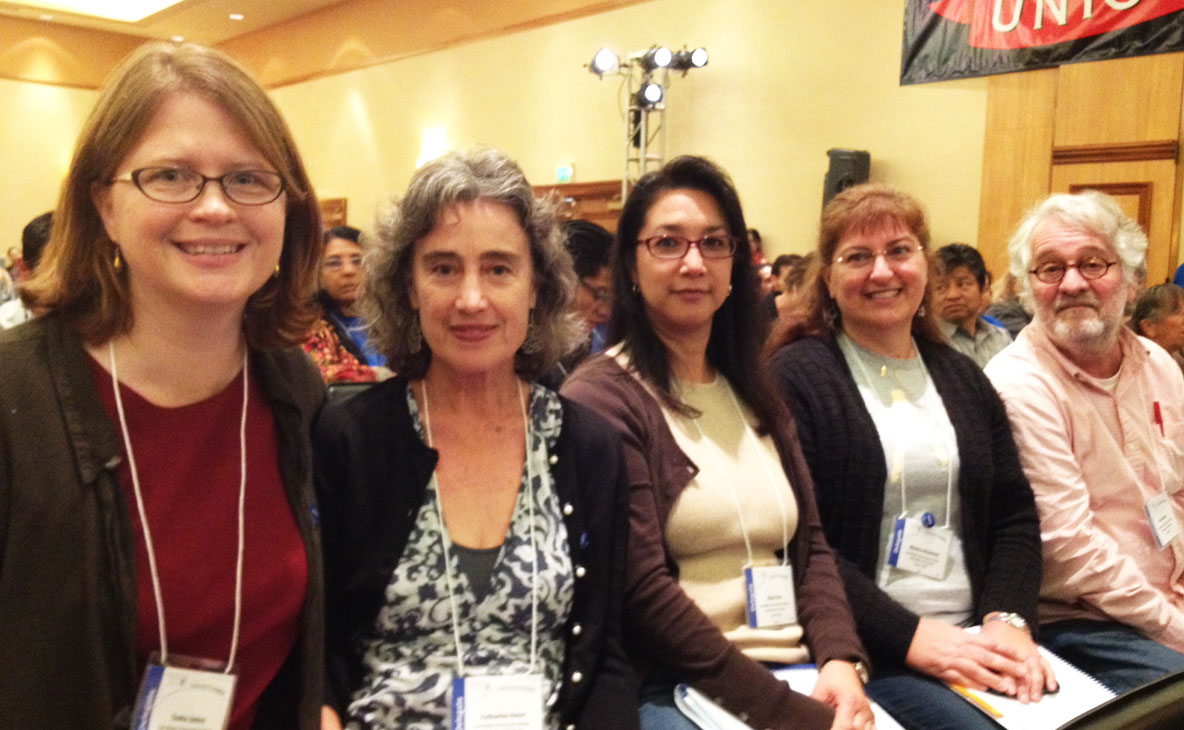
Are conservative forces hell-bent to “Wisconsonize” the rest of the country?  Will STRS run out of money for teachers’ pensions?  Are the changes in Repeatability Standards taking the community out of community colleges?  These are just a few of the questions that kept us glued to our seats at the 72nd California Federation of Teachers Convention.  Our Local sent delegates (l. to r. in photo at left) Teeka ConventionDelegatesJames, Katharine Harer, Nina Floro, Monica Malamud, and Executive Secretary, Dan Kaplan, to the statewide gathering from March 21st to 23rd in Manhattan Beach.  We joined over 600 participants — teachers, staff and students — to listen to inspirational speakers, attend workshops and reinvigorate our fighting spirit. 

“Who else–besides us—will fight for public education”  – Randi Weingarten

AFT National President, Randi Weingarten, exhorted the packed auditorium to be “solution-driven and bad ass.” Weingarten zeroed in on the enemies of public education – the forces behind the Vergara case, wealthy interests such as the Koch brothers and David Welsh: “Big money wants to take away our due process, our pensions and our labor power.  They want to drive a wedge between communities and teachers.  They like an uneven playing field.”  Weingarten brought the crowd to their feet when she declared: “They have all the money in the world.  We have all the people in the world!”

“A Kid Without An Education is a Crime” – Kamala Harris

California Attorney General and former San Francisco DA, Kamala Harris, fired up the crowd with her focus on education.  One of the new initiatives coming out of her office targets the issue of elementary school truancy.  According to Harris, some elementary school districts have a truancy rate as high as 40%, and research shows that children who can’t read by the end of third grade drop out by high school.  Truancy among children is often closely related to issues of poverty: kids with asthma, dental or vision problems that are often untreated, kids in foster care or in homes where parents are working round-the-clock.  Harris declared herself, “the top cop of the biggest state in the country”, and she’s on a mission to improve graduation rates and keep kids in school before they end up “in the ER or jail.” 

Harris’ other education-related initiative focuses on reducing recidivism and targets 18-24 year old low-level offenders.  As Harris said,  “They’re considered adults, but we all know that 18-24 year olds make bad decisions.  They need support.” In a project she spearheaded when she served as DA in San Francisco, re-offenses in this age group decreased from 54% to 10%.  Now a pilot project she’s directing in Los Angeles focuses on young unmarried fathers. She’s brought the courts, K-12 schools and community colleges together with the larger community to help get the dads on track: job-trained, employed, giving child support to the moms and staying out of jail.

No Se Puede Charters! 

A lively panel discussion, Reclaiming the Promise of Public Education, brought together teachers, administrators, parents and community members from three school districts where strategic alliances are being built to defend public education.  In Morgan Hill, the teachers’ union, along with the school district, parents and community activists are fighting a charter school corporation that employs enrollment strategies to segregate Latino kids while siphoning funding away from public schools.  Theresa Sage, president of the Morgan Hill teachers’ union, shared their story.  Working together, they were successful in influencing the local school board to deny the charter corporation government bonds; they organized a petition drive and held a highly successful educational summit to inform the community about the threats to public education from charter schools.  Mario Banuelos, a parent and community leader, shared the Morgan Hill rallying cry:  No se puede charters!

The Jefferson Elementary school district, just down the road from Skyline, has been working closely to strengthen ties between schools, parents and community.  Melinda Dart, president of their teachers union, described a program that started with a series of family education workshops held in the evenings, where parents were asked what they wanted from their schools and the union listened.  Building on these relationships, the union packed school board meetings, ran a strong candidate for the board, and put on a wildly successful Saturday conference for families and teachers, with 400 adults and 300 children participating.

Debbie Forward, an organizer for the Palomar Faculty Federation, described a labor alliance she’s helped to build in their community that will create a broad base for local school board elections.  Forward said, “We want to identify, vet and endorse real candidates, not lesser of two evil candidates.”

California: the 8th Largest Economy in The World 

CFT President Josh Pechthalt, in his State of the Union address, surveyed the good news and the bad news. California, the 8th largest economy in the WORLD, is 51st in the nation in library-to-student ratio and 45th in nurse-to-student.  That works out to one nurse to every 2800 kids.  But the good news is that a new bill, AB 1955, “Healthy Kids, Healthy Minds” would provide a nurse for every school and a mental health professional, and it would ensure that libraries are open before and after school.  

More bad news: the ACCJC is out of control and Brice Harris has failed to stand up to the agency; the Vergara case is costing enormous amounts of money and time to fight and seriously threatens due process; and we desperately need to amend Proposition 13 to protect homeowners and small businesses while forcing big business to pay their fair share of taxes.  The good news is that the defense of CCSF has been strong and has garnered positive results; the Fair Property Tax Reform movement is working on legislation that will amend Prop. 13; the oil severance tax campaign is up and running; and the CFT’s Strategic Campaign Initiative/Quality Public Education Campaign organizing grants are “creating and deepening ties” between schools and community partners. A last potentially good news item: the CFT is working on a new model of restorative justice to take the place of suspensions and expulsions as an antidote to the school-to-prison pipeline.  

“We Are Born To Be Here Right Now In This Place” – Reverend William J. Barber II

Every single one of the more than 600 people at the convention were held in rapt attention by guest speaker Reverend William J. Barber II, the President of the North Carolina NAACP and the organizer of the Moral Movement.  Barber began his speech by stating:  “These are serious times.  Fifty years after the War on Poverty, now we step on people who are hurting, attacking programs like Medicare, Pell Grants, Headstart and Social Security. That’s pretty low.”  Barber has reached out to people across all faiths and backgrounds with his Moral Mondays in North Carolina, protesting huge cuts in education spending and the passage of a voter suppression bill.  What began with a few hundred people gathering on Mondays and marching to protect healthcare and voting rights, education, anti-poverty programs and the rights of the LGBT community, has swelled to hundreds of thousands on certain Moral Mondays.  

This is Barber:  “Any time a mean and extreme element tries to fool Americans into denying education, healthcare and voting rights and then advocates tax cuts for the wealthy and more guns in people’s hands, we got to fight back!  We are born to be here right now in this place. We don’t have time to be morbid and depressed.”

And: “Abortion and homosexuality are not the moral debate.  How you treat the poor and the sick – that’s the moral question.  We’ve got to unpack the moral debate.  Bring it on!”

We rose out of our seats over and over to applaud Reverend Barber’s ideas, his commitment and his eloquence as he spoke to us in the rousing tradition of Martin Luther King and the great leaders of the civil rights movement.  His definition of morality cuts through pretense and political posturing and goes straight to the heart of social justice:  “We are called to deeply moral and deeply constitutional values.  Fight back!  Push forward!”  Reverend William J. Barber II rocked the soul of the 72nd CFT Convention. 

AFT 1493 Communication Awards

Last, but not least, our local once again won a number of awards for our publications. In the category of Best Six-or-more Page Newsletter, The Advocate, by Eric Brenner, Editor, won Second Place. In the category of Best News Writing, Katharine Harer won Third Place for her article “Community Building vs. Privatization Highlighted at 71st CFT Convention”. In the category of Best Use of Graphics, Donna Bowman won Third Place for her “Collage Art Panels of AFT Local 1493: 1963-2013”. In the category of Best Single Effort, Donna Bowman and Dan Kaplan won Third Place for their “Collage Art Panels of AFT 1493 History: 1963-2013”.